
Blog
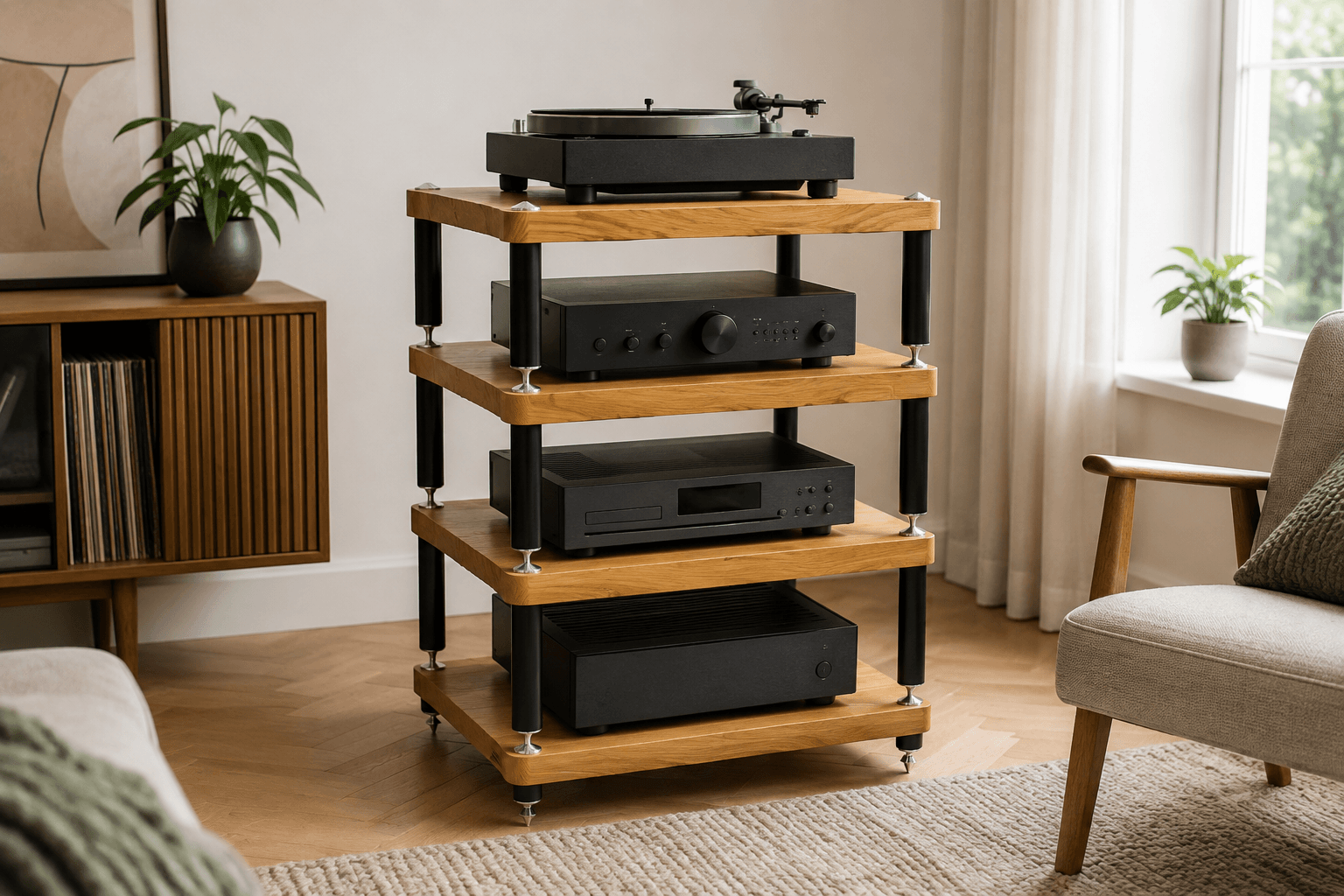
Buying a HiFi Rack: The Complete Guide to Size, Material, and Features
A hifi rack should not be selected based on the product photo, but rather on the equipment intended to go inside it. Width, depth, weight, heat generation, and cable connections determine which design is truly suitable. Anyone who gathers this data before purchasing can objectively compare models and avoid typical problems such as shelves that are too short, overloaded tiers, or a lack of air circulation.
You can find a selection of various models in our “Hifi Racks” category. Please use the product specifications there to cross-reference with your own list of equipment, rather than as a substitute for taking measurements beforehand.
Create a list of equipment before buying a hifi rack
Note down the width, height, depth, and weight for each component. When doing so, take into account not only the housing but also protruding controls, equipment feet, heat sinks, and the turntable lid if opened.
When considering depth, you must also account for connectors and cable bends. An AV receiver might appear compact on the spec sheet but require significantly more space once HDMI, network, and speaker cables are connected. You should factor in this extra space before making your choice.
Correctly comparing the usable dimensions of a hifi rack
External dimensions do not automatically indicate how much actual surface area is available on a given level. Columns, side panels, or frames can reduce the usable width. Similarly, the clearance height between two shelves is more important than the overall height of the unit.
Check that all the appliance’s feet are resting fully on the surface and that the controls remain easily accessible. For turntables, it must also be possible to open the dust cover upwards and, if necessary, backwards.
Load Capacity and Center of Gravity When Buying a HiFi Rack
Compare the weight of each component with the permissible load capacity of the specific shelf level. A high total load capacity for the entire HiFi rack does not automatically mean that every individual shelf can support the same amount of weight.
It makes sense to place heavy amplifiers and power amps lower down, as this keeps the center of gravity low. Also, allow for a reasonable margin rather than constantly pushing equipment to its absolute limits.
Plan for ventilation for amplifiers and receivers
Warm electronics require clear ventilation openings and the clearances specified in the operating instructions. This information takes precedence over general recommendations for a few centimeters of clearance.
Open racks facilitate natural convection. With enclosed compartments, the intake and exhaust airflow must function reliably. A fan can provide assistance but should not be used to compensate for an inherently cramped layout.
Select the material and surface finish for the hifi rack
Wood, metal, glass, and composite structures differ in terms of appearance, maintenance requirements, and structural design. Atacama uses Eiche and Bambus for the production of its hi-fi racks. However, the material alone does not reliably indicate load-bearing capacity or quality; factors such as shelf thickness, span, connection points, and manufacturer specifications are equally important.
In the living room, factors such as susceptibility to scratching, fingerprints, and lighting also play a role. Whenever possible, examine surfaces under real-life lighting conditions and select care products suited to the specific coating.
Check cable management and maintenance access before purchasing
Plan the rear just as carefully as the front. Cables must not be crushed or sharply kinked, and it should be possible to disconnect plugs without moving the entire hifi rack. Leaving a small amount of slack (a service loop) makes future maintenance easier.
For more complex systems, label similar cables at both ends. Power strips and power supply units require a fixed, accessible, and ventilated location. Avoid placing large cable bundles directly behind equipment that generates heat.
Modular HiFi Rack and Future-Proofing
If the system is expected to grow, a modular setup may be a sensible choice. Before purchasing, check which tiers, columns, or expansion parts are available and whether different generations are truly compatible with one another.
A spare rack unit is useful when a specific future need is foreseeable. However, excessive vertical clearance makes a rack larger and potentially top-heavy. Therefore, plan based on a realistic scenario for upcoming equipment replacements.
Test the site and soil before planting
Mark the outer dimensions of the planned rack on the floor using masking tape. Take into account baseboards, doors, walkways, power outlets, and the necessary clearance from the wall. A model might fit the floor plan yet still block access to connections.
The surface underneath matters, too. Adjustable feet make leveling easier on slightly uneven floors. On parquet or tile, hard contact points may require suitable surface protection.
Conclusion: Technical specifications first, design second
Buying a good hifi rack begins with a list of equipment and concludes only after checking the placement area and ease of use. Once internal dimensions, load capacity, ventilation, cable space, and stability are confirmed, the design can be the deciding factor among suitable models. This approach minimizes the risk of a bad purchase and ensures there is headroom where it is actually needed.
Frequently Asked Questions About Buying a HiFi Rack
How deep should a hifi rack be?
It should provide sufficient depth for the device, its connectors, and a realistic cable bend. Therefore, measure the fully connected component rather than just the bare housing.
Where should the heaviest piece of equipment be placed?
It is usually sensible to have a sufficiently load-bearing bottom shelf, as this lowers the hifi rack’s center of gravity. Nevertheless, the specific position must still provide enough surface area and ventilation for the device.
Are modular hifi racks always better?
No, they are primarily more flexible if future expansions are likely. For a permanent, fixed layout, a non-modular model can be simpler and perfectly adequate.
Should there be a reserve level?
Adding an extra shelf makes sense if the addition of another component is realistically planned. Conversely, excessive precautionary empty space makes the hifi rack unnecessarily large; this should be weighed against stability and visual appeal in the living space.
Which details should I check before placing an order?
Check the usable width, depth, clear shelf height, load capacity per shelf, and available spacings or modules. Supplement this data with the ventilation requirements for your equipment and the dimensions of the actual installation site.
Helpful guides before buying a HiFi rack
- How big should a HiFi rack be? How to measure correctly – Here is how to correctly determine width, depth, height, and shelf spacing.
- How much weight can a HiFi rack support? Safely checking load capacity – This is how you compare the weight of the units and the permissible load for the individual levels.
- The most common mistakes when buying a HiFi rack – You should avoid these typical planning errors before placing your order.


