
Blog
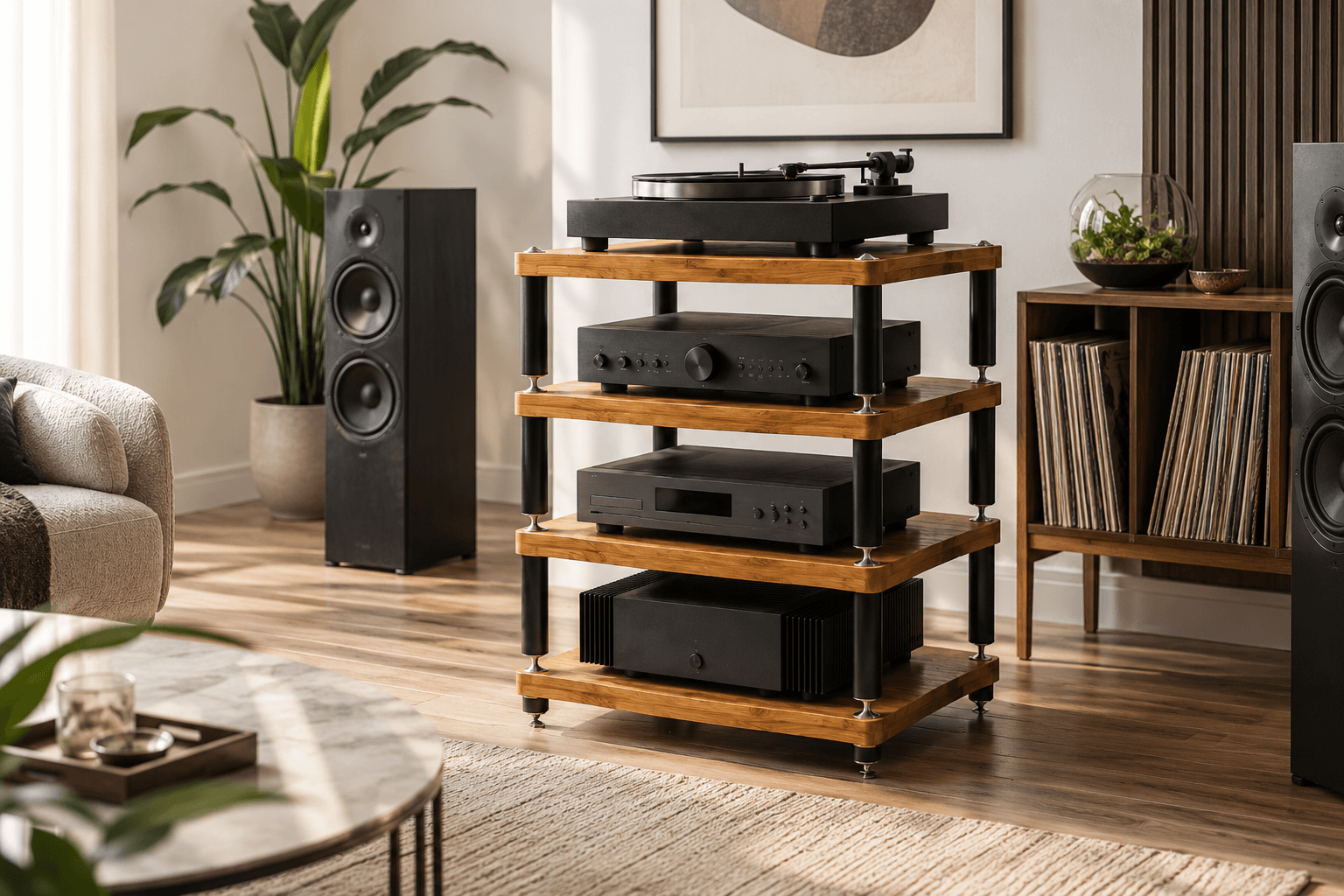
Why do you need a HiFi rack?
A HiFi rack is not strictly necessary for every HiFi system. However, when multiple components, heavy amplifiers, a turntable, numerous cables, or devices that generate significant heat are involved, a specially designed rack offers practical advantages. The main benefits include secure installation, clearly documented load capacity, unobstructed airflow, and easy access.
In our “HiFi Racks” category, you can compare various designs. Whether such a piece of furniture is worthwhile for your own system should be decided based on the equipment and the room itself, rather than on a sweeping promise.
A HiFi rack provides secure shelving surfaces
Each component is assigned a dedicated shelf with a width, depth, and load capacity matched to the actual weight of the equipment. This is particularly important for large integrated amplifiers and power amplifiers, which can be significantly heavier than compact streamers or DACs. Atacama offers a wide range of hi-fi rack combinations, spanning from compact racks to zur reference-class models designed for heavy, oversized equipment.
It makes sense to place heavy components on a lower shelf. This lowers the hi-fi rack’s center of gravity, while lighter source components can be positioned higher up. All equipment feet should rest fully on the surface to avoid unnecessary point loads or unstable overhangs.
Ventilation in HiFi racks becomes manageable
Amplifiers, receivers, and power supply units generate heat during operation. An open or well-ventilated rack makes it easier to keep ventilation slots unobstructed and to maintain the clearances specified by the equipment manufacturer.
It is important not to stack heat-generating components closely on top of one another simply to save space. Providing a dedicated level creates room for natural convection while also facilitating maintenance and cleaning. With enclosed designs, intake and exhaust airflow must be carefully planned.
Cable management remains accessible
A hifi system often requires power, signal, network, and speaker cables. A suitable rack allows these cable runs to be organized so that plugs are not under tension and cables are not crushed between the furniture and the wall.
Labeling cable ends and using small service loops saves a great deal of time during future modifications. Power strips and external power supplies should also be given a secure, well-ventilated spot rather than simply lying loose behind components that generate heat.
HiFi rack and turntable: stable placement
A turntable is more sensitive to mechanical movement than many digital sources. A stable, level top surface makes operation easier and helps create the conditions necessary for clean signal tracking.
On floors with significant springiness, however, a different location or a suitable wall mount may still be advisable. A rack does not automatically solve every impact noise problem, but it does create a controllable starting point.
Improve the organization and operability of the system
Appliances are not only positioned more safely but are also easier to access. Buttons, displays, drawers, and turntable lids require unobstructed clearance for operation. Checking these operational clearances before making a selection prevents a situation where a device fits the available space geometrically but is barely usable in everyday life.
Cleaning and troubleshooting also become easier when the rear panels and connections remain accessible. A well-planned rack thus reduces not only visible cable clutter but also the effort required for maintenance.
A modular HiFi rack can grow with the system
Many audio systems evolve over the years. An additional streamer, a phono stage, or a new amplifier may require different shelf spacing or more surface area. Modular systems are practical in such cases, provided that suitable expansion components remain available in the long term and are mechanically compatible.
Even so, one should not plan for unlimited reserve capacity. An oversized rack takes up more space and alters the center of gravity. It makes sense to provide for a realistic expansion capability that aligns with your purchasing plans.
Living comfort and technology can be combined
A hifi rack doesn’t have to look like a technical laboratory. Wood, metal, and various surface finishes allow for a design that blends into the living room. The key is to select materials and colors only after the technical requirements have been met.
Placement within the room also matters. Direct sunlight, proximity to radiators, and awkward traffic paths should be avoided. Speakers and the listening position should not be compromised simply to ensure the rack sits symmetrically against a particular wall.
Conclusion: A HiFi rack is worthwhile when there are clear technical requirements
The greatest advantage of a HiFi rack is not a vaguely promised sonic improvement, but rather a controlled environment for the system. Load capacity, ventilation, cable access, stability, and expandability can all be specifically tailored to the equipment on hand. The more complex or heavy the system becomes, the more apparent these benefits can be in everyday use.
Frequently Asked Questions about HiFi Racks
Does a HiFi rack always improve the sound?
No, an audible improvement cannot be guaranteed for every system. The reliable benefit lies primarily in secure placement, unobstructed airflow, tidiness, and—for sensitive equipment—controlled mechanical conditions.
Can you simply stack HiFi equipment?
Nur wenn Herstellerangaben, Gewicht und Lüftung das ausdrücklich zulassen. In vielen Fällen ist eine eigene Ebene besser, weil Wärme entweichen kann und die Geräte leichter erreichbar bleiben.
Does a small streaming system need a HiFi rack?
Not necessarily, provided a few lightweight units are securely placed on a suitable piece of furniture. A hifi rack becomes more relevant once you add more components or heavy equipment, or when there are specific requirements regarding ventilation and cable management.
Why are leveling feet practical?
They help level out minor unevenness in the floor and ensure that the hifi rack is stable and level. A level surface is especially important for a turntable.
Is a modular hifi rack always the better choice?
No, if your system remains unchanged over the long term, a standard hi-fi rack can be perfectly adequate. Modularity is worthwhile primarily when future expansions are a realistic possibility and the appropriate modules actually remain available.
More guides: When and why a HiFi rack makes sense
- What Is a HiFi Rack? Construction, Functions, and Differences from Standard Furniture – Fundamentals of construction, function, and differences compared to standard furniture.
- Buying a HiFi Rack: The Complete Guide to Size, Material, and Features – Turning practical benefits into a concrete purchasing decision.
- Planning a modular HiFi rack – Here’s how to plan your system using suitable shelves and future expansions.


