
Blog
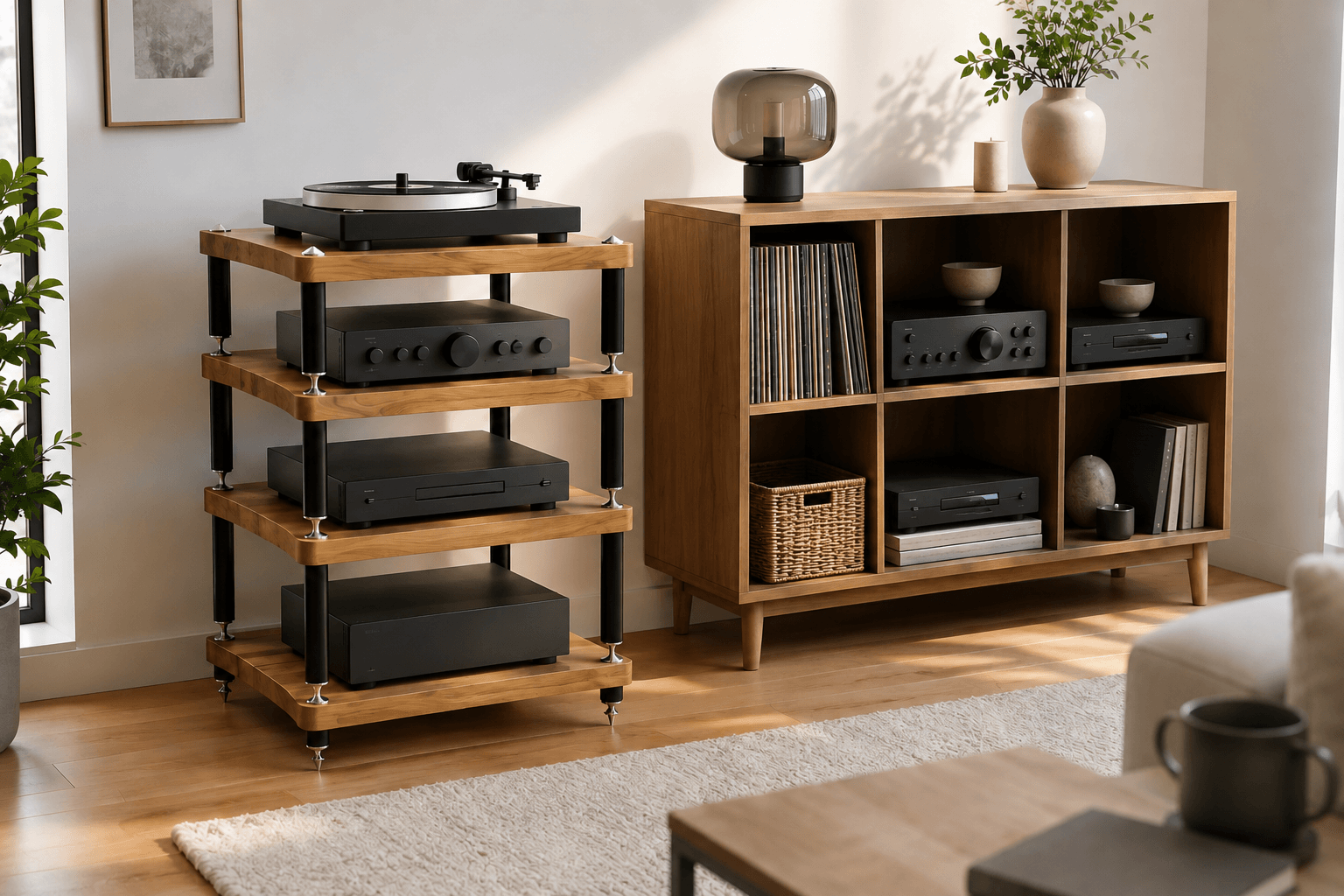
HiFi rack or standard furniture? The key differences
At first glance, a HiFi rack and a standard piece of living room furniture might seem to serve the same purpose: supporting amplifiers, source components, and accessories. In practice, however, they often differ in terms of usable depth, specified load capacity, ventilation, cable management, and expandability. Therefore, the decision should not be based on the furniture’s label, but rather on whether it suits the specific equipment and the intended location.
Those wishing to compare solutions specifically designed for audio components will find a variety of designs in our “HiFi Racks” category. However, an existing sideboard or shelf may still be suitable, provided its technical characteristics are carefully assessed.
When standard furniture suffices for HiFi
For a small, light system, a sturdy piece of furniture can be completely sufficient. It is crucial that all device feet rest securely, that there is enough depth for plugs and cables, and that warm components can give off their waste heat. The back must also be accessible so that connections can be reached without strong pulls or sharp bends in the cable.
Problems arise when the load-bearing capacity of a floor is unknown or a device fits only because ventilation clearances are ignored. In such cases, a visually suitable solution is not automatically technically appropriate.
Compare load capacities for HiFi racks and living room furniture
With specialized hifi racks, the permissible load for individual shelves is often clearly specified. In contrast, standard furniture sometimes lists only a general load capacity or provides no reliable figure at all. Consequently, heavy integrated amplifiers and power amplifiers, in particular, should not simply be placed on a shelf based on a visual estimate.
Note the weight of each component and compare it with the rated load capacity of the intended shelf level. It is generally advisable to place heavy equipment on the lower levels, as this lowers the center of gravity of the entire unit.
Check depth, rear panel, and cable compartment
The depth of a device’s chassis is merely the base figure. Power plugs, HDMI cables, speaker wires, and RCA or XLR connectors require additional space and must not be crushed between the furniture and the wall. Baseboards can also reduce the usable clearance from the wall.
A solid back panel can make access difficult or restrict air circulation. However, do not remove or modify load-bearing furniture components without the manufacturer’s approval. A back panel can contribute to the structural stability of the unit.
Ventilation is crucial for both types of furniture
Amplifiers and AV receivers generate heat, regardless of whether they are placed in a hifi rack or on a sideboard. Ventilation slots must remain unobstructed, and the minimum clearances specified in the owner’s manual take precedence over general rules of thumb.
Closed doors and confined compartments increase the need for careful planning. If heated air cannot escape upwards or towards the rear, a different location or a better-ventilated piece of furniture should be chosen. Additional fans are only worthwhile if they complement a well-conceived airflow strategy.
Leveling and stability of the HiFi rack
Specialized hi-fi racks often feature adjustable feet or spikes that allow for the compensation of minor floor irregularities. This option is limited with many standard pieces of furniture. An unstable, wobbling setup is particularly problematic for heavy equipment and turntables. Every hi-fi rack from the manufacturer
Atacama utilizes special spikes capable of compensating for floor unevenness of up to 1 cm, depending on the model.
Check the alignment first while the unit is empty, and then again after it has been fully loaded. Carpets or other yielding surfaces may settle, making subsequent readjustment necessary.
Consider expandability and device replacement
Anyone who frequently alters their setup benefits from easily accessible levels and a design that accommodates additional modules or varying spacing. Conversely, a fixed piece of furniture can work very well if the equipment configuration remains stable over the long term.
Even so, the reserve capacity should be planned realistically. An unnecessarily large piece of furniture takes up space and can raise the center of gravity; conversely, a lack of reserve capacity can quickly necessitate a complete replacement of the furniture when the next device is added.
Compare appearance and visual impact realistically
A standard sideboard often integrates technology into the living space in a particularly unobtrusive way. An open HiFi rack displays the components more prominently and—thanks to materials like wood, metal, or other finishes—can also create a cozy, inviting look. Which design is better, therefore, depends on the room and personal priorities.
However, technical suitability should be determined before aesthetics. Once only suitable options remain, factors such as material, color, proportions, and maintenance requirements can be the deciding factors.
Decision test for existing furniture
Assign a specific location to each device and check five factors: footprint, load-bearing capacity, heat, cable space, and access for operation. Also, simulate removing a device. If doing so requires removing several adjacent components or moving the entire piece of furniture, the solution will be difficult to maintain in everyday use.
Conclusion: Choose the HiFi rack or furniture based on the system
A standard piece of furniture is not inherently unsuitable, nor is a specialized rack automatically better in every situation. The decisive factors are the measurable requirements of the equipment. By evaluating load capacity, depth, airflow, stability, and maintenance needs, one can objectively compare both solutions and avoid making a purchase based solely on a product photo.
Frequently Asked Questions about HiFi Racks
Is a hifi rack automatically superior in terms of sound?
No, the furniture’s designation alone does not guarantee an improvement in sound quality. However, factors such as stability, ventilation, load-bearing capacity, and—for mechanically sensitive equipment—specific vibration issues can certainly be assessed.
Is it permissible to remove the back panel of a standard piece of furniture?
Only if the structure is not weakened as a result and the manufacturer permits the modification. A back panel can be part of the bracing system, so it should not simply be cut out.
When is a dedicated HiFi rack particularly worthwhile?
Specified load capacities and good accessibility are particularly helpful when dealing with heavy, warm, or numerous components, as well as frequent system changes. A surface that can be precisely leveled can also be practical for a turntable.
How do I find out the load capacity of a piece of furniture?
Consult the manufacturer’s technical documentation or check with the manufacturer or dealer. If reliable information is unavailable, do not place heavy equipment on a floor of unknown capacity by simply testing it out.
Can a lowboard be a good alternative to a HiFi rack?
Yes, provided the internal dimensions, load capacity, ventilation, and cable space are suitable for the system. A lowboard requires more wall width but allows devices to be placed side by side and integrates well into a TV setup.
Further comparisons regarding HiFi racks and living room furniture
- HiFi rack or lowboard? Which style suits your system? – Compare a vertical rack solution and a wide lowboard in terms of everyday use.
- Open or closed HiFi rack? Pros and cons – Here is how ventilation, access, dust protection, and the living experience differ.
- Buying a HiFi Rack: The Complete Guide to Size, Material, and Features – Key Technical Criteria for Choosing the Right Unit.


