
Blog
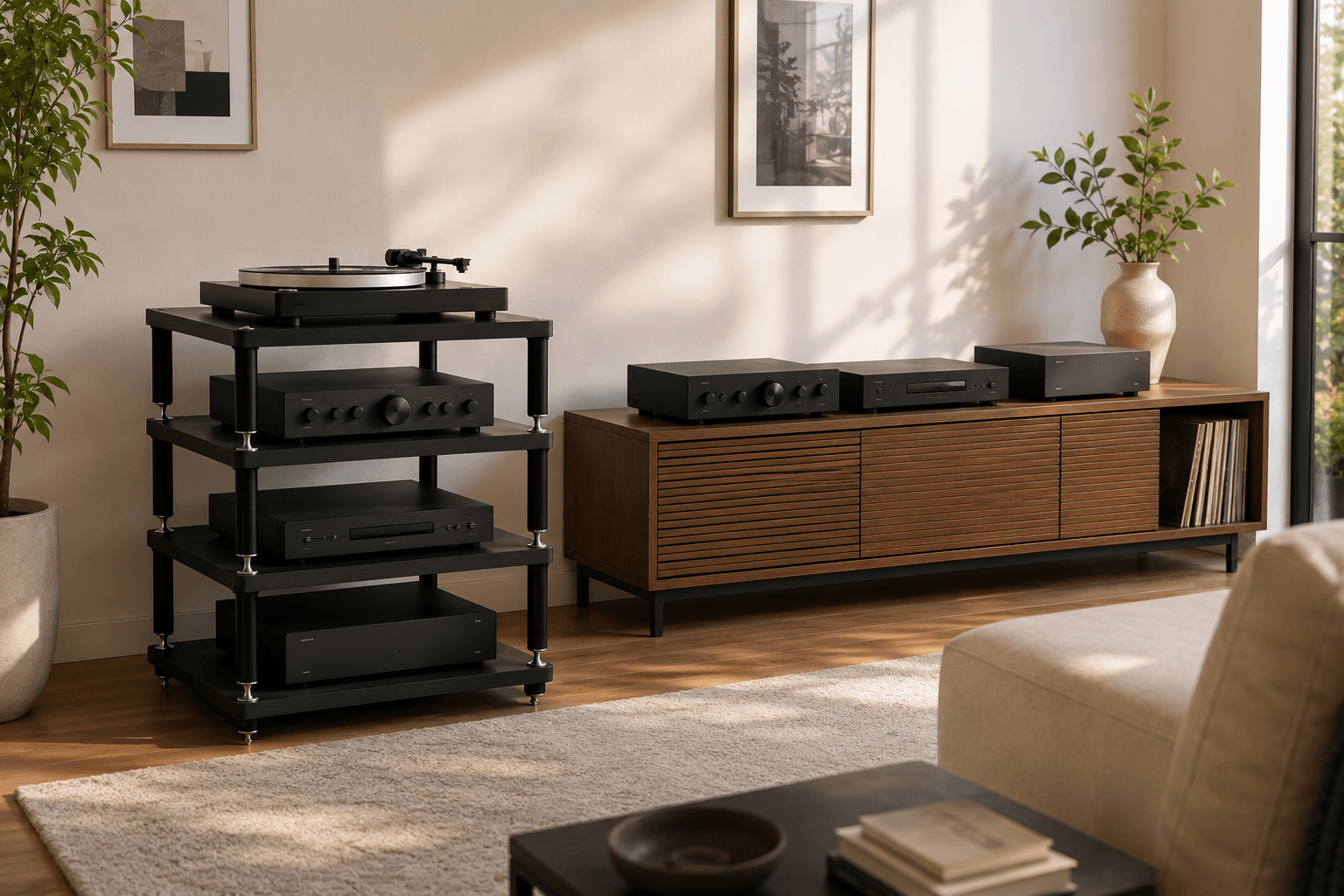
HiFi rack or lowboard? Which style suits your system?
When considering a HiFi rack or a lowboard, you should base your choice on the equipment you already own. Usable depth, shelf spacing, load capacity, and airflow can be objectively assessed, providing a better basis for your decision than generic product claims.
Those wishing to compare suitable models will find a variety of designs in the “HiFi Racks” category. However, it is best to first establish your own requirements so that technical specifications can be meaningfully evaluated.
HiFi rack saves floor width
Vertical tiers consolidate multiple components within a small footprint and keep cabling in one place. Measure the depth with the connectors attached; power, HDMI, and speaker cables require realistic bending radii and must not be crushed between the hifi rack and the wall.
Practical check: Apply the requirements to the existing equipment and the intended location. Note down any missing dimensions or manufacturer specifications before committing to a HiFi rack. Atacama offers extra-wide HiFi racks across several product lines, allowing a larger number of components to be accommodated.
Lowboard offers wide surface areas
Units can be placed side by side, and a television is often easier to integrate, though this requires more wall width. A spirit level—used both lengthwise and crosswise—reveals any slight misalignment. Adjustable feet are tweaked incrementally until all contact points bear the weight and the furniture no longer wobbles.
For a real-world test, you should mentally walk through the eventual setup process: installing the device, connecting the cables, operating it, and removing it again. If any of these steps require improvisation, it is worth considering a different arrangement.
Realistically assess the disadvantages of both designs
A tall hifi rack can be visually dominant, whereas a lowboard often features deep or enclosed compartments with limited air circulation. Enclosed compartments require a clear airflow path from intake to exhaust; doors or back panels must not restrict convection to the point where heat becomes trapped.
A brief checklist containing the truly relevant specifications helps when evaluating the downsides. This ensures the decision to choose a HiFi rack or a lowboard remains transparent and allows for updates after changing equipment without requiring a complete redesign.
Don’t let the Hi-Fi rack dictate the room acoustics
Speakers and the listening position should be sensibly positioned first, before determining the layout for the remaining furniture. Once everything is fully set up, check the stability, airflow, and cable routing again; only then will it become clear whether the plan works under real-world conditions.
Check the setup not only with the furniture empty but also with the planned equipment in place. Weight, cables, and heat alter the practical conditions and can make a configuration that initially seemed suitable uncomfortable to use.
Compare device types and operating heights
Turntables often benefit from being placed on an easily accessible top shelf, whereas AV equipment can be conveniently located near the television. Material choice and load-bearing capacity should be evaluated separately. Whether a shelf can safely support heavy equipment depends on its construction and the manufacturer’s specifications, not merely on whether it is made of wood, metal, or MDF.
Allow only as much extra space as is reasonable for your specific setup. Additional space is useful if it serves a concrete purpose; however, unnecessary height or depth does not automatically make the hifi rack better.
Decide on a HiFi rack or lowboard using a dimensioned plan
Check floor space, wall width, cable routes, heat and future appliances together on one simple floor plan. After changing the device, the heat development should be assessed again. A more powerful amplifier or receiver can significantly change the requirements for existing rack space.
Document the final solution, including dimensions and pin assignments. This facilitates future modifications and prevents the need to re-estimate details that have already been resolved whenever a device is replaced.
Conclusion: Plan the HiFi rack based on the system
A HiFi rack serves primarily as a functional base for the audio system. Good planning is evident when equipment is securely positioned, heat is effectively dissipated, connections remain accessible, and future reconfiguration is possible.
Frequently Asked Questions About HiFi Racks and Lowboards
Is a lowboard unsuitable for HiFi?
No, a lowboard can work well from a technical standpoint, provided the depth, load capacity, and ventilation are suitable. It generally requires more wall width, whereas a vertical rack consolidates multiple devices within a smaller floor footprint.
Where should a record player be placed?
A stable and horizontal footprint is particularly important. If the floor is very resilient, a different location or a suitable wall mount may make more sense than adding more accessories to the HiFi rack.
Which design is easier to expand?
A hifi rack makes sense if future expansion is a realistic prospect and compatible modules remain available. Check the product series, compatibility, and the maximum practical height before planning for extra capacity merely as a precaution.
Which solution creates a calmer look in small rooms?
This depends on the specific system and the intended HiFi rack. Check the dimensions, manufacturer specifications, and ease of use together to ensure the solution not only fits physically but also remains safe and accessible for everyday use.
More guides on HiFi racks
- Setting up a HiFi rack in the living room – How to seamlessly integrate the rack, speakers, and equipment into your living space.
- AV Receivers in HiFi Racks – Considerations regarding proximity to the TV, depth, ventilation, and cabling for AV systems.
- How big should a HiFi rack be? How to measure correctly – Here is how to compare space requirements and proportions using specific measurements.


