
Blog
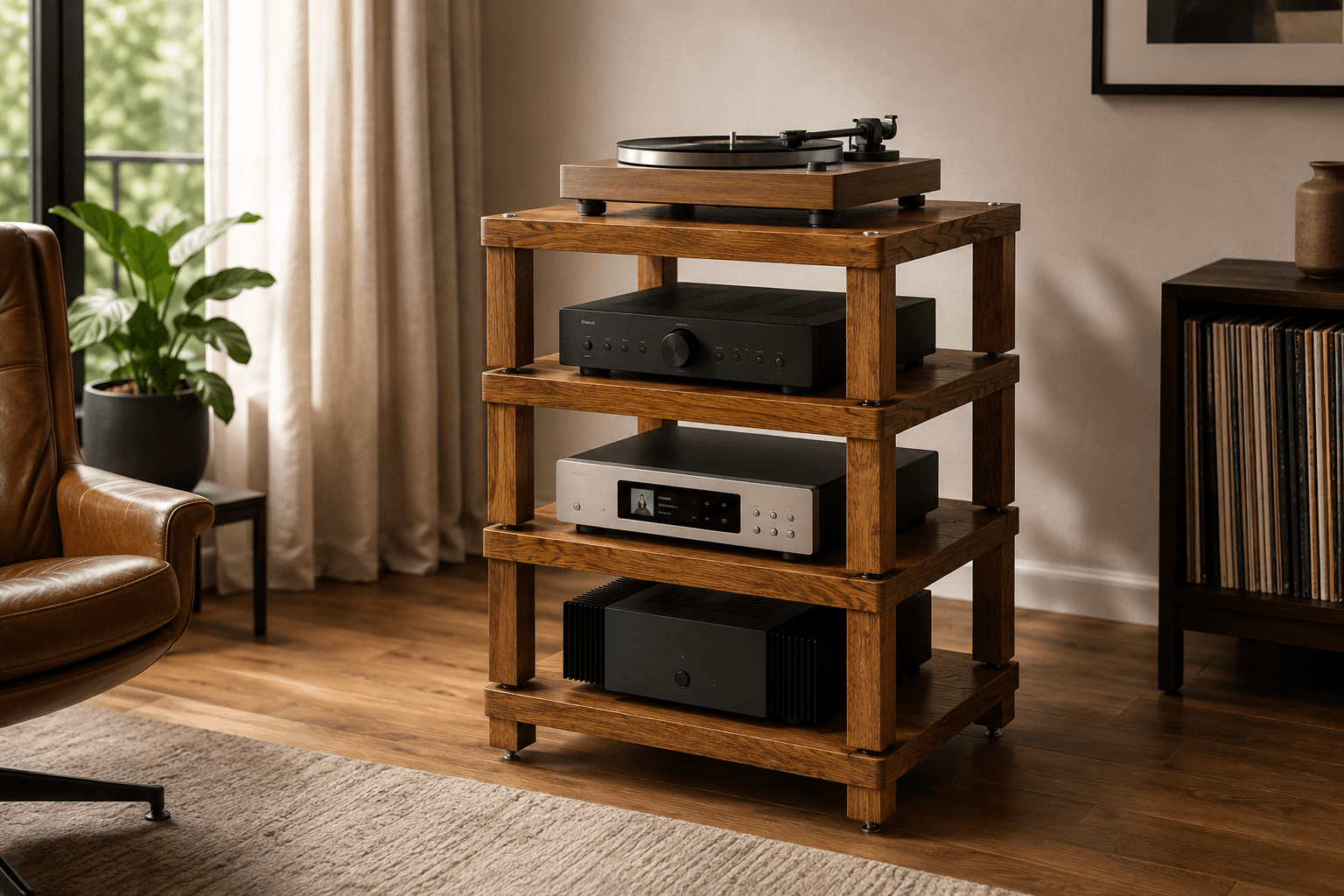
What Is a HiFi Rack? Construction, Functions, and Differences from Standard Furniture
A hifi rack is a piece of furniture specifically designed to accommodate audio components such as amplifiers, streamers, CD players, DACs, or turntables. Unlike a standard shelf, the design process focuses not only on aesthetics and storage space but also on load-bearing capacity, usable surface area for equipment, air circulation, cable management, and stability.
If you wish to compare different versions, you will find a variety of designs in our “Hifi Racks” category. Whether a specific rack is the right choice depends on your existing system, the room, and the requirements of the individual components.
Assembling a HiFi rack: shelves, pillars, and feet
Many hifi racks consist of multiple tiers connected by pillars, frames, or side panels. Depending on the system, the spacing is either fixed or can be adjusted to suit the equipment using different pillar heights or modules.
The feet play an important role in ensuring stability. Adjustable feet or spikes can compensate for minor floor irregularities. On delicate parquet or tile flooring, it is advisable to use suitable protective pads to prevent hard contact points from damaging the surface.
The roles a hifi rack plays in everyday use
The most obvious function is to support the components securely. To achieve this, each shelf must provide sufficient surface area and a load-bearing capacity appropriate for the weight of the equipment. All equipment feet should rest fully on the surface, and heavy components are typically placed on the lower shelves.
Atacama offers hi-fi racks suitable for virtually all equipment sizes and weights.
Accessibility is just as important. Buttons, displays, drawers, ports, and cables should remain accessible. A rack is far more practical in day-to-day use if a device can be serviced or replaced without having to dismantle half the system first.
HiFi rack or standard shelf: the practical differences
A sturdy, standard shelf unit can certainly work for a small system. The difference lies not merely in the name, but in the extent to which the furniture is specifically designed for audio equipment. With a specialized rack, load capacity, shelf spacing, and cable access are often more clearly documented.
Usable depth also plays a major role. An amplifier requires space behind its chassis for power, signal, and speaker cables. A solid rear panel or insufficient clearance from the wall can result in connectors being crushed or lateral strain being placed on the sockets.
Properly planning ventilation in a hifi rack
Amplifiers, AV receivers, and some power supply units generate significant heat during operation. Ventilation slots must not be obstructed by a shelf, accessories, or another device placed above them. The clearance distances specified in the respective operating manual must be observed.
Open racks facilitate natural air circulation. With enclosed designs, there must be sufficiently large intake and exhaust air paths. Multiple heat-generating devices should not be stacked closely on top of one another—and not merely for reasons of space.
Evaluate materials and construction sensibly
Hifi racks are made of wood, metal, glass, or combinations of these materials. Wood can create a cozy feel, metal appears sleek and technical, and glass looks visually light. However, load-bearing capacity cannot be reliably inferred from the material itself.
Key factors include the thickness of the base, the span, connection points, contact surfaces, and the specified load-bearing capacity. When making a selection, one should also consider maintenance requirements, susceptibility to scratches, exposure to direct sunlight, and the rest of the furnishings.
For whom is a specialized hifi rack worth it?
A specialized rack is particularly useful when dealing with multiple components, heavy amplifiers, electronics that run quite hot, or a turntable. Those who frequently reconfigure their system also benefit from easily accessible cable routing and modular expansion options.
For a very small streaming setup consisting of a few lightweight components, another piece of stable furniture may suffice. The decision should therefore always be based on measurable requirements rather than a generic “HiFi” label.
Choosing a HiFi rack to match your system
Before purchasing, create a list of your devices, noting their width, depth, height, and weight. When calculating depth, include plugs and cable bends; for height, factor in the necessary ventilation clearance. For a turntable, you must also account for the lid when open.
Next, mark the area in the room where the item will be placed. Check for doors, baseboards, power outlets, and traffic paths, as well as the distance to radiators or areas exposed to direct sunlight. Decisions regarding materials and colors should be made only after the technical suitability has been confirmed.
Conclusion: Choosing a HiFi rack based on function
A good hifi rack provides a stable, sturdy, and well-ventilated foundation for the system. Its practical value lies primarily in ensuring that components sit securely, cables remain accessible, and future modifications can be made without the need for improvisation. Whether a dedicated rack is necessary can be objectively determined by considering dimensions, load capacity, heat dissipation, and usage requirements.
Frequently Asked Questions About HiFi Racks
Is any shelf suitable as a hifi rack?
Only if the mounting surface, load-bearing capacity, stability, and ventilation are suitable for the equipment. In the case of heavy or heat-generating components, missing manufacturer specifications should not be replaced by estimates.
Does a hifi rack have to be open?
No, enclosed solutions can also work, provided the supply and exhaust air systems are adequately sized. Doors and rear panels must not obstruct the airflow paths specified by the equipment manufacturer.
How many levels make sense?
Plan for a level for each component that should not be safely stacked, and include a realistic buffer if necessary. Conversely, an unnecessarily tall rack offers no automatic advantage.
Is an expensive hifi rack automatically better?
No, price alone guarantees neither suitable dimensions nor higher load capacity or better ventilation. What matters is whether the design meets the requirements of your specific system and features quality workmanship.
Where should a turntable be placed in a hifi rack?
A stable top tier is often practical, as it keeps the turntable easily accessible and allows the dust cover to be opened freely. On springy floors, it is also worth considering whether a different location or a wall mount would be a better option.
Further guides on HiFi racks
- Buying a HiFi Rack: The Complete Guide to Size, Material, and Features – How to choose a rack based on dimensions, load capacity, ventilation, and features.
- HiFi rack or standard furniture? The key differences – A direct comparison of specialized racks, shelving units, and other living room furniture.
- Why do you need a HiFi rack? – The key practical benefits, ranging from secure parking spaces to expandability.


