
Blog
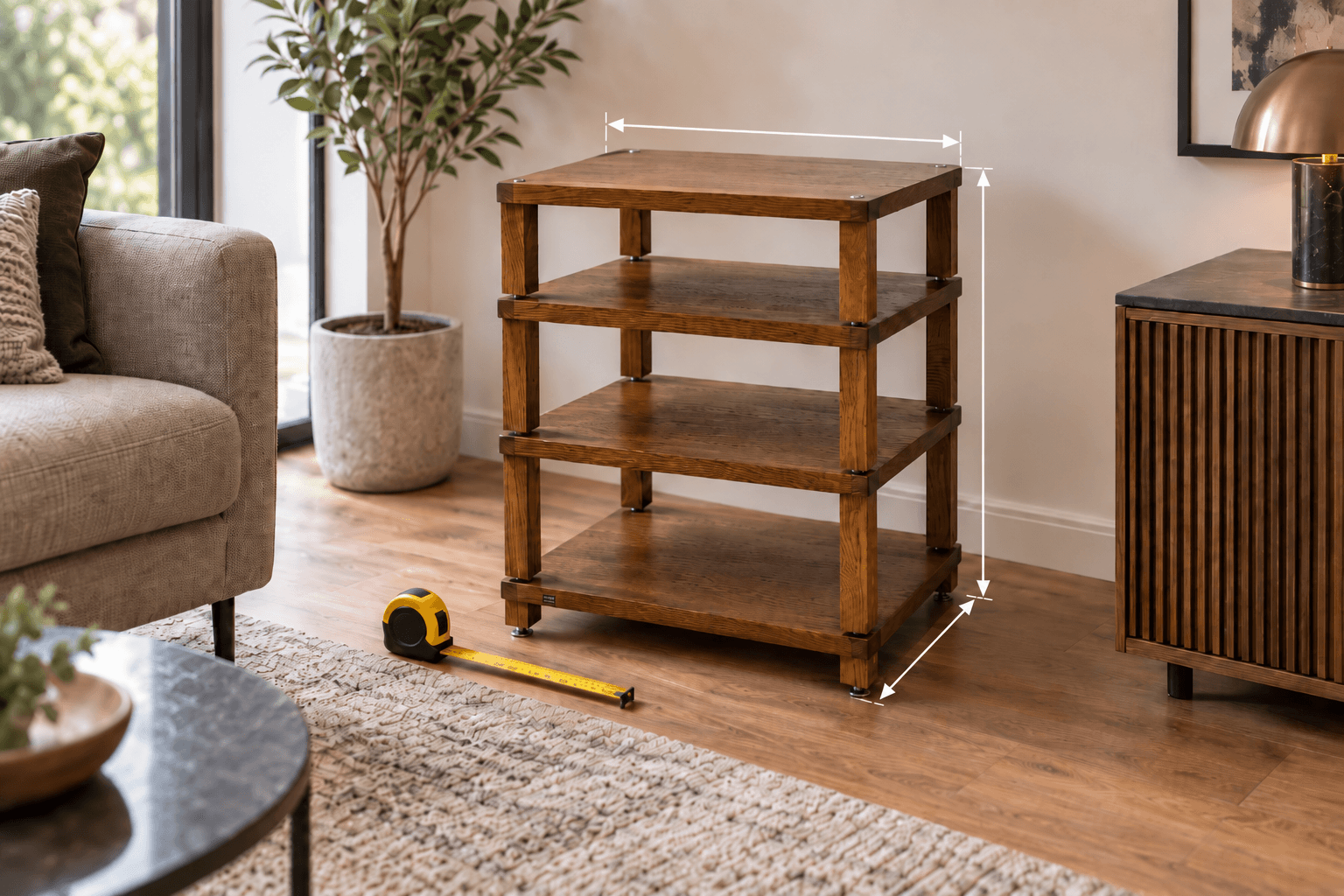
The most common mistakes when buying a HiFi rack
Many poor purchasing decisions regarding HiFi Racks stem not from inferior products, but from deciding too quickly based on appearance. It is often only after delivery that one realizes the amplifier—including its plugs—is too deep, the shelf lacks sufficient load-bearing capacity, or the receiver cannot dissipate heat effectively. Systematic planning can help avoid most of these issues.
As with Atacama, use product images merely to supplement the technical specifications, as internal dimensions, shelf spacing, and load ratings are more important for determining actual suitability.
Underestimating external dimensions and cable depth
The external dimensions of the rack reveal little about the amount of usable space remaining between the pillars or side panels. Therefore, measure each piece of equipment at its feet and chassis, and also take into account controls, heat sinks, and the turntable lid when open.
The depth required for plugs and cables is frequently overlooked. HDMI, power, and speaker cables need a realistic bending radius; a cable must not be pressed against the wall or subjected to lateral strain at the connector.
Guess the load capacity and ignore the center of gravity
Do not rely on the visual appearance of a floor to judge its strength. The decisive factor is the load-bearing capacity specified by the manufacturer for the exact area where the equipment is to be placed. Factor in a safety margin rather than constantly pushing the limits of the maximum load.
Heavy amplifiers and power amps should generally be placed lower down. This lowers the hifi rack’s center of gravity, ensuring greater stability when operating the unit or swapping out other components.
Neglecting ventilation and equipment clearances
Devices that generate heat must not be crammed into a compartment simply because they physically fit. Ventilation slots must remain unobstructed, and the minimum clearance distances specified in the respective operating manual take precedence over general rules of thumb.
Stacking multiple devices can also be problematic. In addition to heat, the extra weight can put strain on the casings and make it difficult to access buttons or ports.
Do not plan for insufficient reserve capacity or the wrong rack height
A system often changes over the years. A realistic reserve capacity or a modular system prevents the need to replace the entire hifi rack when upgrading to the next streamer or phono preamplifier.
However, having more spare capacity is not automatically better. An unnecessarily tall hifi rack looks more imposing, raises the center of gravity, and can make operation inconvenient. Therefore, plan only for expansions that are genuinely likely.
Cable management and maintenance overlooked
If a device can only be connected by pulling the HiFi rack away from the wall, the setup is difficult to maintain in everyday use. Leave a service access space behind the components and label the cable ends—especially for AV receivers with numerous connections.
Power strips and power adapters also require a secure, well-ventilated location. Tightly bundled cables, pinched cords, or hard-to-reach power switches will cause unnecessary hassle later on.
Do not include the room and household in the planning
Check the location with regard to baseboards, doors, carpeting, radiators, and direct sunlight. A HiFi rack might fit physically but still block a walkway or stand unsteadily on a soft surface.
When children or pets are involved, additional considerations include stability against tipping, hot appliances, glass, and accessible cables. These factors should be addressed before purchase, rather than only after the system has been fully set up.
Conclusion: Good planning prevents most bad purchases
Selecting a HiFi rack based on internal dimensions, load capacity, ventilation, cable space, and placement significantly reduces the risk of costly compromises. While design remains important, it should only be the deciding factor once technical suitability has been established.
Frequently asked questions about mistakes when buying a HiFi rack
What is the most common measurement error when it comes to HiFi racks?
Often, only the depth of the unit’s housing is measured. Plugs, cable bends, feet, and controls can significantly increase the actual space required.
How much load-bearing reserve should be factored in?
There is no universal percentage figure, as designs vary. The important thing is not to consistently push the manufacturer’s limits to the max and to factor in any additional weight to be added later.
Can a HiFi rack that is too small be modified later?
Only if the system is explicitly designed to be modular and suitable extensions are available. Unauthorized drilling or modifications to the columns can compromise stability and load-bearing capacity.
Should you choose based on design or technology first?
First, the dimensions, load capacity, ventilation, and location must be suitable. Once that is established, you can choose from the technically suitable models based on material, color, and style.
Is an extra spare shelf always a good idea?
No, a reserve is only helpful if expansion is realistic. An unnecessarily large HiFi rack takes up more space, can increase the center of gravity and often appears heavier in the room.
More guides to help you avoid mistakes when buying a HiFi rack
- Buying a Hi-Fi Rack: The Complete Guide to Size, Material, and Features – Key Criteria for a Systematic Selection Before You Order.
- How big should a HiFi rack be? How to measure correctly – Here is how to take into account internal dimensions, cable space, shelf spacing, and footprint.
- How much weight can a HiFi rack support? Safely checking load capacity – This is how you avoid making the wrong purchase due to misjudging load capacity and weight distribution.


