
Blog
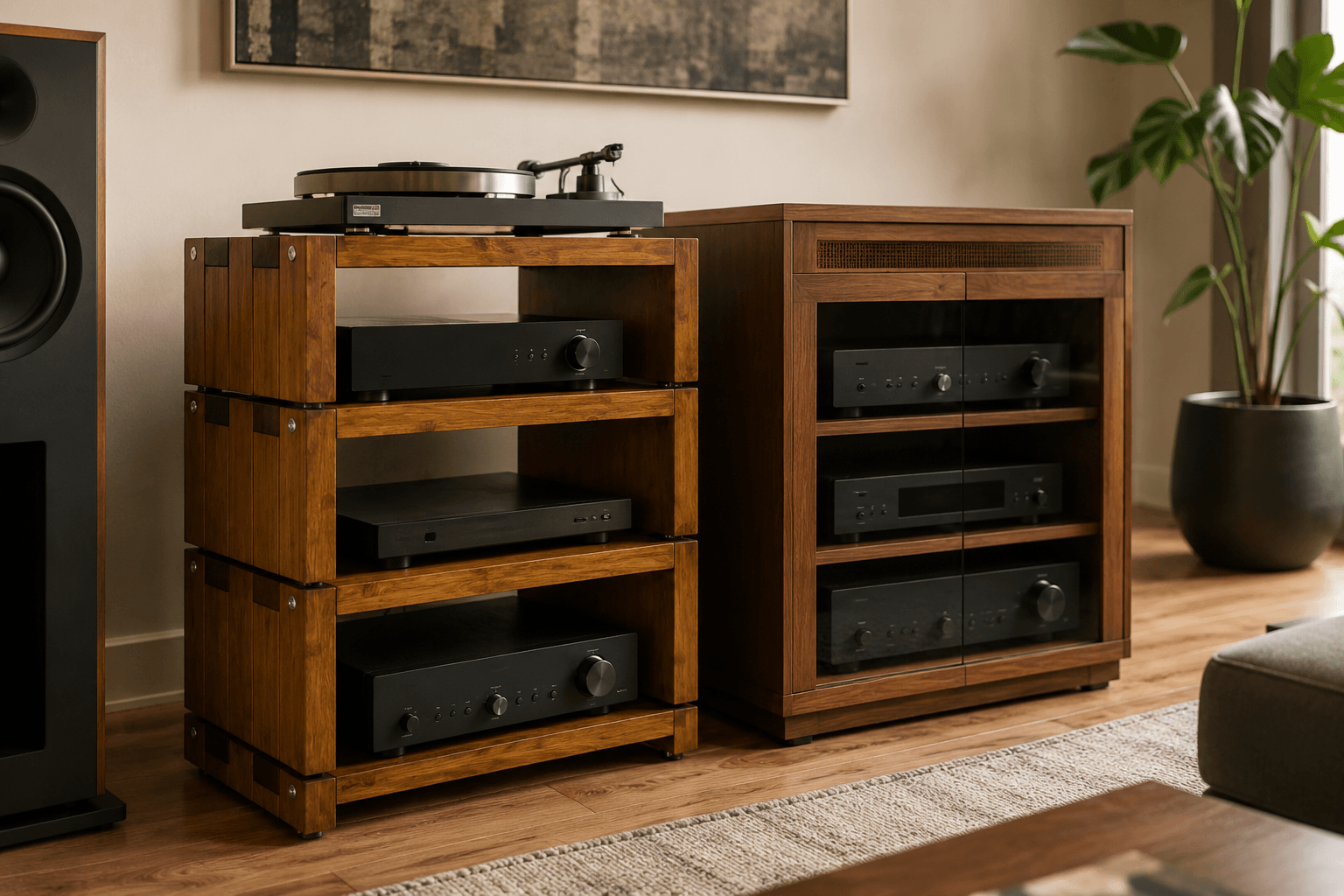
Open or closed HiFi rack? Pros and cons
Both open and closed HiFi racks can securely accommodate a HiFi system, yet they prioritize different aspects. Open designs facilitate air circulation and cable access, whereas closed units make the equipment less visually prominent and may limit direct access. Consequently, the most suitable design depends on factors such as heat generation, ease of use, household conditions, and interior style.
You can find various types of models in our “HiFi Racks” category. When making your selection, you should first consider the equipment and its ventilation requirements before deciding between doors and open sides.
Open HiFi Rack: Advantages for Ventilation and Access
Open racks generally allow heated air to escape upwards and to the sides without obstruction. This is particularly beneficial for integrated amplifiers, power amplifiers, and AV receivers, provided the required clearances are maintained.
Cables and connections also remain easily accessible. Devices can be swapped out more easily without having to remove back panels or pull the entire piece of furniture away from the wall. This offers a significant practical advantage for setups that are frequently modified.
Disadvantages of an open HiFi rack
Exposed equipment is more visible. Consequently, cables, power supplies, and the backs of units require more careful organization if the rack is to maintain a calm appearance in the living room. At the same time, dust accumulates more easily on the devices and shelves.
Children or pets can more easily reach exposed cables and warm components. In this context, secure cable routing, a stable base, and—where appropriate—additional protective measures are particularly important.
Enclosed HiFi rack: clean look, requiring more planning
Doors and side panels can visually conceal the equipment and limit direct access to buttons or cables, creating a very tidy look in the living area.
However, the technical complexity increases because factors such as heat dissipation and ease of use require greater consideration. An enclosed compartment is suitable only if there is adequate airflow—both intake and exhaust—and the equipment manufacturers’ clearance requirements are met. Atacama primarily manufactures open HiFi racks to ensure good ventilation. Yet, thanks to a well-conceived design, enclosed models like the Atacama Elite Eco24 Reference are also perfectly suited for high-end components.
Ventilation concept for an enclosed HiFi rack
Warm air rises. Therefore, an airflow path is advisable that allows cooler air to flow in at the bottom and heated air to escape at the top or from the upper rear section. Small, decorative openings are not necessarily sufficient for high-performance electronics.
If passive convection is insufficient, suitable quiet fans can help. However, before installing them, one should check the manufacturer’s recommended clearances, the extent of the equipment installation, and the temperature during prolonged use. A fan is no substitute for an installation setup that is fundamentally too cramped.
Remote control and operability behind doors
With standard infrared remote controls, a closed door can block the line of sight to the device. Some systems use radio frequency, network control, or external IR receivers, but this should be clarified before selecting the furniture.
Physical controls must also remain accessible. If a door repeatedly protrudes far into the walkway or has to be left open in front of the turntable, a theoretically elegant solution can quickly become inconvenient in everyday use.
Dust and cleaning for open and closed racks
Enclosed compartments can reduce the direct ingress of dust but do not prevent it entirely. Ventilation openings still allow for air exchange, and cable entry points often remain open.
Open racks, on the other hand, are generally easier to clean from all sides. The key is to protect equipment from liquids and avoid spraying cleaning agents directly toward ventilation slots or connectors.
HiFi rack in households with children or pets
Closed doors can restrict direct access but do not automatically resolve issues regarding tipping hazards or heat buildup. Tall hifi racks must be stable; heavy equipment should be placed as low as possible, and any anti-tip mechanism used must be compatible with the wall.
With open designs, cables should not hang down in easily accessible loops. Hot tubes or heat sinks require a location that makes accidental contact difficult without obstructing necessary air circulation.
Which design suits which system?
A system with multiple heat-generating components and frequent equipment changes often benefits from an open rack. Conversely, a compact system with moderate heat output can work very well even inside a well-designed enclosed cabinet.
A simple simulation helps with the decision: assign a location to each device, map out the cable routes, and consider how you would install, operate, and remove it. If these workflows function smoothly and the ventilation specifications are suitable, the chosen design is fundamentally sound.
Conclusion: Decide whether to leave it open or closed after use.
The better solution is not automatically an open or a closed rack. A good HiFi rack must reliably accommodate load requirements, airflow, cable access, and ease of use; only then should the desired aesthetic impact be the deciding factor.
Frequently Asked Questions About Open and Closed HiFi Racks
Can an AV receiver be placed behind a closed door?
Yes, provided that the necessary ventilation clearances, air intake and exhaust, and accessibility for operation are ensured. Check the temperature during prolonged use and refer to the receiver manufacturer’s specifications.
Does an enclosed HiFi rack always need a fan?
No, if there is sufficient passive airflow, additional ventilation may be unnecessary. A fan only becomes worth considering if heat cannot be reliably dissipated when the device is fully populated.
Does an enclosed rack provide complete protection against dust?
No, because openings for cables and ventilation remain. Dust ingress may be reduced, but regular cleaning is still necessary.
What is particularly important with tube amplifiers?
Tube amplifiers can reach high surface temperatures and often require ample open space. Consequently, an open or well-ventilated setup is frequently easier to implement safely than a tightly enclosed compartment.
Which design is more practical for frequent modifications?
Open HiFi racks generally make it easier to access cables, connections, and mounting points. With enclosed furniture, it is worth checking whether the back panel, doors, and cable routing allow for equipment changes without having to dismantle the entire unit.
Helpful guides on open and closed HiFi racks
- Properly ventilating amplifiers – How to plan for unobstructed airflow and prevent heat buildup in warm electronics.
- AV Receivers in HiFi Racks – The demands deep, warm, and heavily cabled AV components place on the rack.
- Making HiFi racks child- and pet-proof – How to address accessibility, cables, hot equipment, and tip-over safety.


