
Blog
Ventilate the amplifier properly
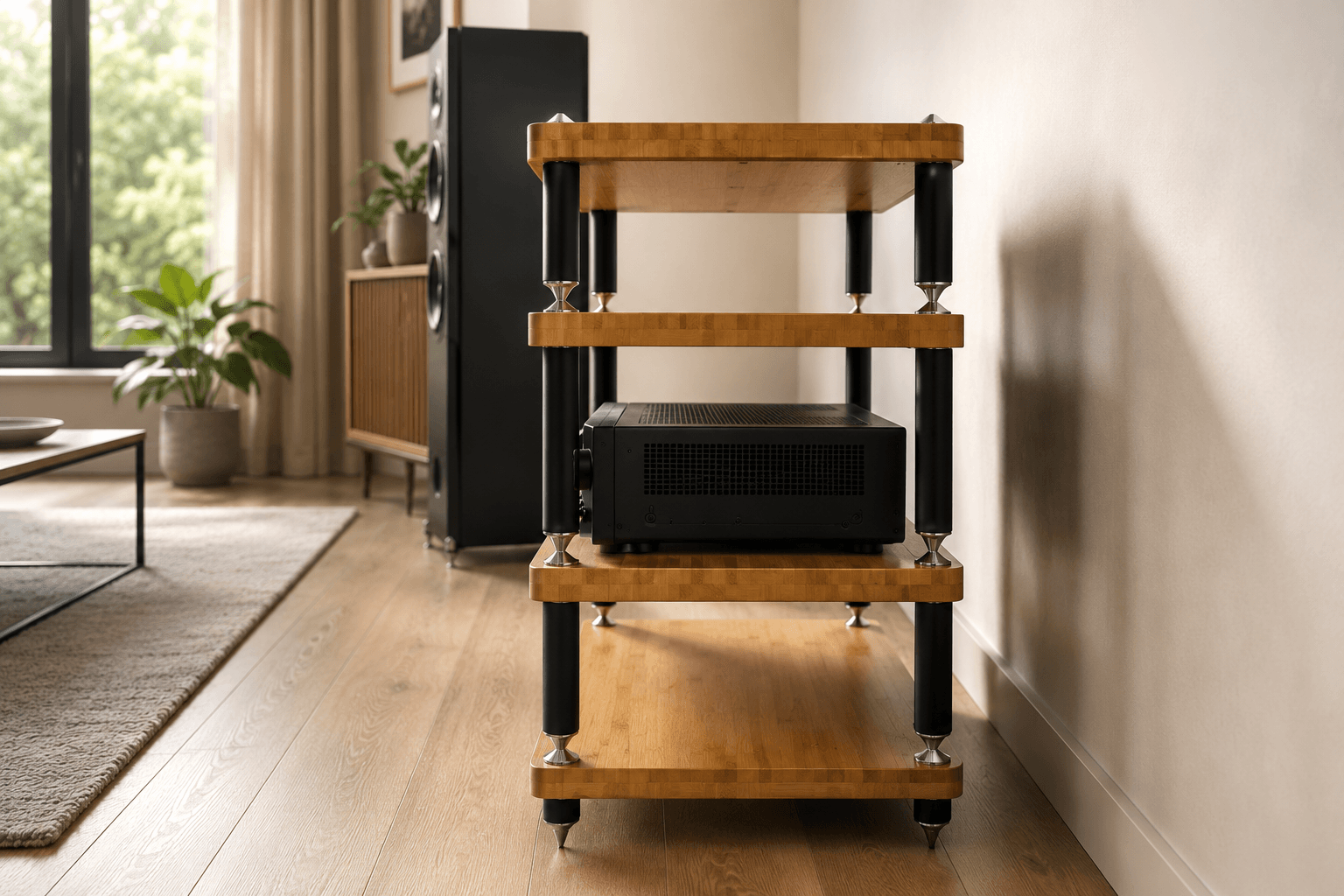
Amplifiers emit heat during operation and require unobstructed airflow. The amount of clearance needed depends on the specific device, its power consumption, its design, and the manufacturer’s specifications. A HiFi rack can facilitate ventilation if the shelf spacing and open areas are appropriately planned from the outset.
Anyone wishing to compare different Hi-Fi racks will find a variety of options in our “HiFi Racks” category. However, the amplifier’s instruction manual remains the most important source of information regarding minimum clearances and permissible placement.
Keep the ventilation slots on the amplifier completely unobstructed
Check where the device draws in air and where heated air exits. Openings on the top, sides, or bottom must not be blocked by a rack shelf, accessories, textiles, or a second device placed directly against them.
Decorative objects should not be placed on warm electronic devices either. They can block airflow and make it difficult to assess the actual temperature of the casing.
Correctly sizing the shelf spacing in a HiFi rack
The height of the unit alone is not a sufficient metric. Add the clearance specified by the manufacturer and consider whether there is a solid shelf directly above. With modular Hi-Fi racks — such as those from Atacama — a wider spacing between pillars may be advisable for components that run hot.
Excessively narrow clearance between two heat-generating devices can raise the temperature of both components. When multiple amplifiers or receivers are housed in the same rack, the total heat generation should be considered collectively.
Enclosed HiFi racks require air intake and exhaust
In an enclosed compartment, cooler air must be able to flow in and heated air must be able to escape. Since warm air rises, openings at the bottom and in the upper section are often advisable. The actual design depends on the furniture and the arrangement of the appliances.
Small cable openings in a rear panel do not automatically constitute an adequate ventilation system. After a period of typical use, check whether significant heat is building up and whether the device manufacturer’s specifications are being met.
When a fan in a HiFi rack can be useful
If passive airflow is insufficient despite adequate spacing, suitable quiet fans can provide assistance. They should be mounted in a way that creates a clear airflow and avoids contact with sensitive cables or components.
Temperature-controlled solutions prevent unnecessary continuous operation. However, a fan should not be used to force an amplifier into a compartment that is fundamentally too small or not approved by the manufacturer.
The location of the HiFi rack affects the temperature
Direct sunlight, radiators, and very warm corners of the room raise the ambient temperature and hinder cooling. A HiFi rack should be positioned so that air can circulate around the unit and the back or exhaust vents are not completely blocked by the wall.
Curtains can also be problematic if they block ventilation openings or come into direct contact with warm housings. Check the setup as it will be in everyday use, rather than just looking at the empty rack during installation.
Monitor the temperature during normal operation
Depending on its design, an amplifier may become quite warm without this necessarily indicating a fault. The manufacturer’s specifications and the device’s behavior are the deciding factors. Protective shutdowns, unusual odors, or recurring thermal issues must be taken seriously.
Do not touch very hot components without protection to estimate their temperature. If the manufacturer provides measurement data or diagnostic functions, these are more reliable than subjective manual checks.
Check for dust and inspect ventilation paths regularly
Dust can accumulate on openings and cooling surfaces. Clean the device only according to the manufacturer’s instructions, and do not spray liquid or compressed air into the housing in an uncontrolled manner.
The hifi rack itself should also remain accessible enough to allow dust to be removed from behind and beneath the equipment. A very cramped compartment not only hinders cooling but also makes regular maintenance difficult.
Do not stack devices without inspection
Placing a small streamer on top of a large amplifier saves space, but it can block ventilation slots and generate additional heat. Furthermore, not every chassis is designed to permanently support the weight of another device.
It is usually easier to manage a dedicated rack level. Even if the equipment manufacturer explicitly permits stacking, factors such as clearances, weight, and access to connections must still be taken into account.
Conclusion: Plan ventilation based on the specific amplifier
A well-ventilated HiFi rack ensures unobstructed airflow, appropriate shelf spacing, and sufficient clearance behind the equipment. General rules regarding clearance in centimeters are less reliable than the amplifier manufacturer’s specifications. Taking into account the specific equipment layout and the actual placement of the unit helps minimize heat buildup and keeps the system easy to maintain.
Frequently Asked Questions About Amplifier Ventilation in HiFi Racks
How much clearance does an amplifier need above it?
This depends on the device and its ventilation openings. Observe the minimum clearances specified in the operating manual and ensure that a rack level above does not obstruct airflow.
Can a streamer be placed on top of the amplifier?
Only if the manufacturer permits this and neither ventilation nor the permissible housing load is compromised. A separate level is usually easier to assess thermally and more accessible.
Does every enclosed HiFi rack need a fan?
No, sufficiently large passive intake and exhaust air paths may suffice. A fan becomes worth considering if the compartment retains too much heat when fully populated, despite maintaining the correct clearances.
What should you do if the amplifier shuts down due to heat?
Switch off the device, allow it to cool down, and identify the cause by referring to the manufacturer’s instructions. Blocked ventilation, restricted placement, or technical defects should not be ignored by continuing to operate the device.
How often should ventilation openings be cleaned?
This depends on dust levels and the environment. Check the openings regularly and clean them only using the methods recommended by the manufacturer, without pushing dirt deeper into the device.
Further guides on amplifier ventilation
- HiFi Rack for Heavy Amplifiers – How to balance load capacity, footprint, and airflow requirements for large amplifiers.
- Tube amplifiers in a HiFi rack – special requirements due to their tall profile and significant heat generation.
- AV Receivers in HiFi Racks – How to Plan for Depth, Cabling, and Ventilation with Complex AV Equipment.


