
Blog
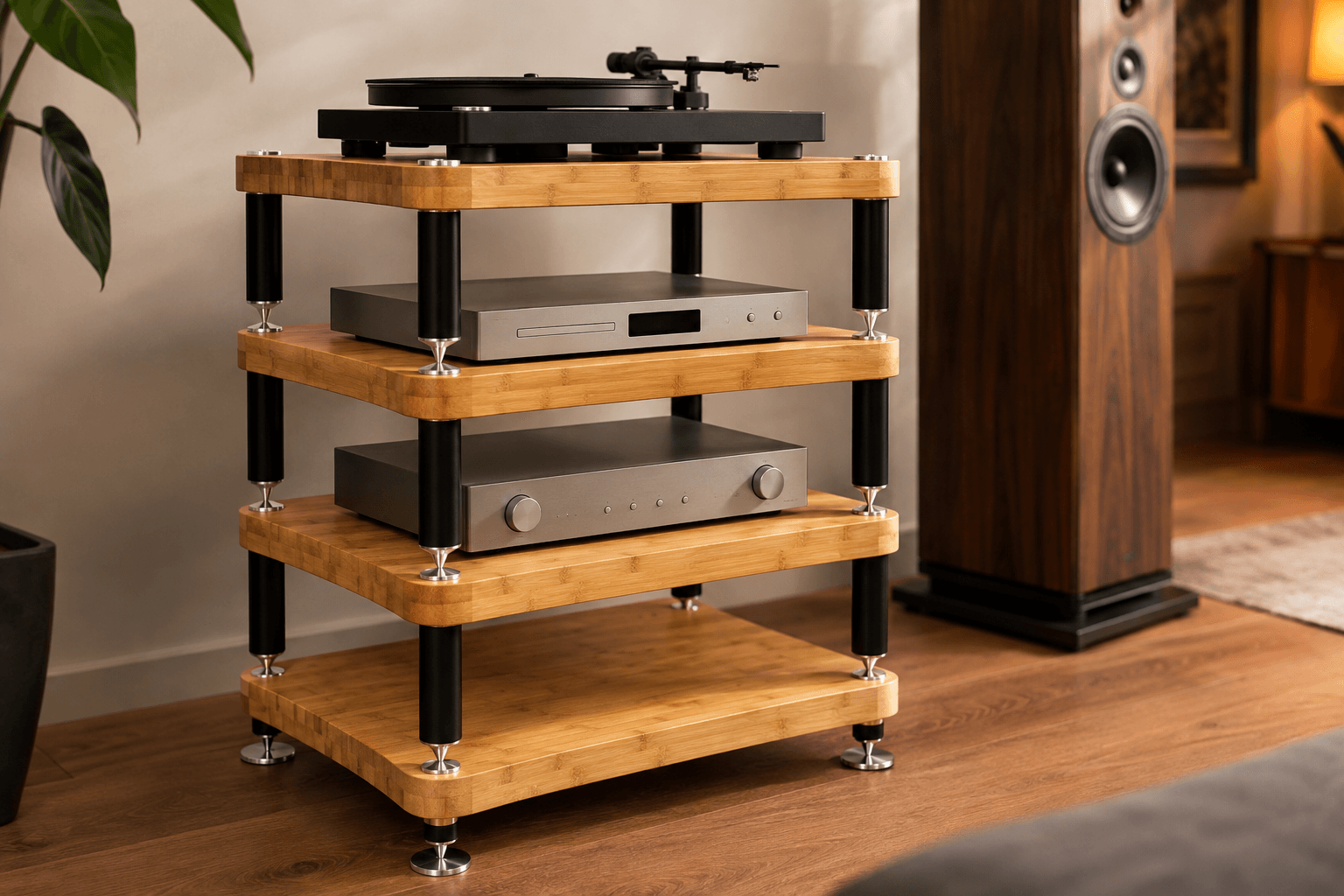
Vibrations and Resonances in the HiFi Rack
There is rarely a universal solution when it comes to vibrations and resonances in a HiFi rack. A HiFi rack must suit the specific equipment, the flooring, and how the room is used; therefore, making a good choice begins with a brief assessment of the situation, not with the color of the furniture.
Those wishing to compare suitable models will find a variety of designs in the “HiFi Racks” category. However, it is best to first establish your own requirements so that technical specifications can be meaningfully evaluated.
Understanding transmission paths on the HiFi rack
Vibrations can reach equipment and furniture via air, the floor, walls, or direct contact. With its HiFi racks, Atacama offers a wide range of options for reducing unwanted vibrations and oscillations. Enclosed compartments require a clear airflow path from the intake to the exhaust. Doors or back panels must not restrict convection to the point where heat becomes trapped.
Targeted examination of sensitive equipment
Mechanical playback systems like turntables behave differently than digital electronics; sweeping generalizations are of little help. In cases of significant footfall noise, relocating the unit closer to a load-bearing wall may be advisable. Depending on the room, a suitable wall mount is another option for turntables.
First, demonstrate a specific problem
Issues such as a skipping stylus, feedback, rattling, or a visibly springy floor are better starting points for assessment than abstract promises regarding sound quality. Delicate floors require suitable protective pads beneath hard feet or spikes. Soft temporary solutions, on the other hand, can compromise stability and do not offer a universal leveling solution.
Set up the HiFi rack with proper mechanical integrity
Play-free mounting, level positioning, and correctly seated equipment feet eliminate many trivial sources of interference. The technical specifications provided by the manufacturers of the HiFi rack and the equipment serve as the technical basis. Where specific values are missing, it is more sensible to make an inquiry than to rely on an estimate based on product photos or general experience.
Check the location of the hifi rack for impact sound
With springy floors, positioning the unit closer to a load-bearing wall or using a wall mount may be advisable. Test the location first with the HiFi rack empty and later when it is fully loaded. Carpeting or other yielding surfaces may settle over time, necessitating readjustment.
Use accessories only as required to address specific issues
Spikes, elastic dampers, or additional mass should address a clearly identified transmission path. If a specific disturbance occurs, change only one factor at a time. This makes it easier to determine whether the location, the floor, a loose component, or a specific coupling is the cause.
Conclusion: Address vibrations in the HiFi rack systematically rather than with a blanket approach
The most sensible way to assess vibrations and resonances is to first consider the specific transmission path. A horizontally aligned HiFi rack assembled without play, combined with a suitable location, eliminates many avoidable sources of interference. Particularly with turntables, it is worth checking whether footfall, a springy floor, or acoustic feedback are actually causing problems.
Spikes, dampers, or additional mass only make sense if they are suited to the specific problem at hand, the supporting surface, and the load on the hifi rack. Testing changes individually while keeping other conditions constant allows for a far better assessment of their impact than relying on general accessory recommendations.
Frequently Asked Questions About Vibrations and Resonances in HiFi Racks
Which devices are particularly sensitive to vibrations?
Mechanical playback systems, such as record players, are particularly sensitive because vibrations from the supporting surface can reach the stylus. In contrast, for digital electronics, a stable setup, adequate ventilation, and secure connections are usually the more important criteria.
Do spikes provide decoupling?
Not automatically. Spikes create small, defined contact points with the floor and—depending on the rack—can also help with leveling; whether they improve a specific vibration issue depends on the surface and the overall setup.
Does more mass always help?
No. Additional mass can alter mechanical behavior but also increases the load on the rack, feet, and floor, and does not automatically resolve the issue of a springy surface. Therefore, it should only be used within permissible load limits and with a clear objective.
How do I test a change effectively?
Change only one factor at a time—such as the location, the support surface, or a vibration damper—while keeping the equipment layout, volume level, and other conditions as consistent as possible. Then, specifically monitor the original issue, such as structure-borne noise, feedback, rattling, or visible movement of the turntable.
When is a different location the better solution?
If the floor is noticeably springy, footsteps are transmitted to the turntable, or the rack is unstable despite correct assembly, you should first try a different location. Positioning the unit closer to a load-bearing wall—or using a suitable wall mount in cases of significant footfall noise—can be more effective than using additional accessories.
Further guides on vibrations in HiFi racks
- Spikes or dampers under the HiFi rack? – How to select accessories to suit the substrate, load, and specific vibration problem.
- HiFi rack for turntables – This is how impact noise, location and orientation influence a mechanically sensitive turntable.
- Does a HiFi rack affect the sound? – A nuanced assessment of mechanical effects, setup, and listening comparisons.


