
Blog
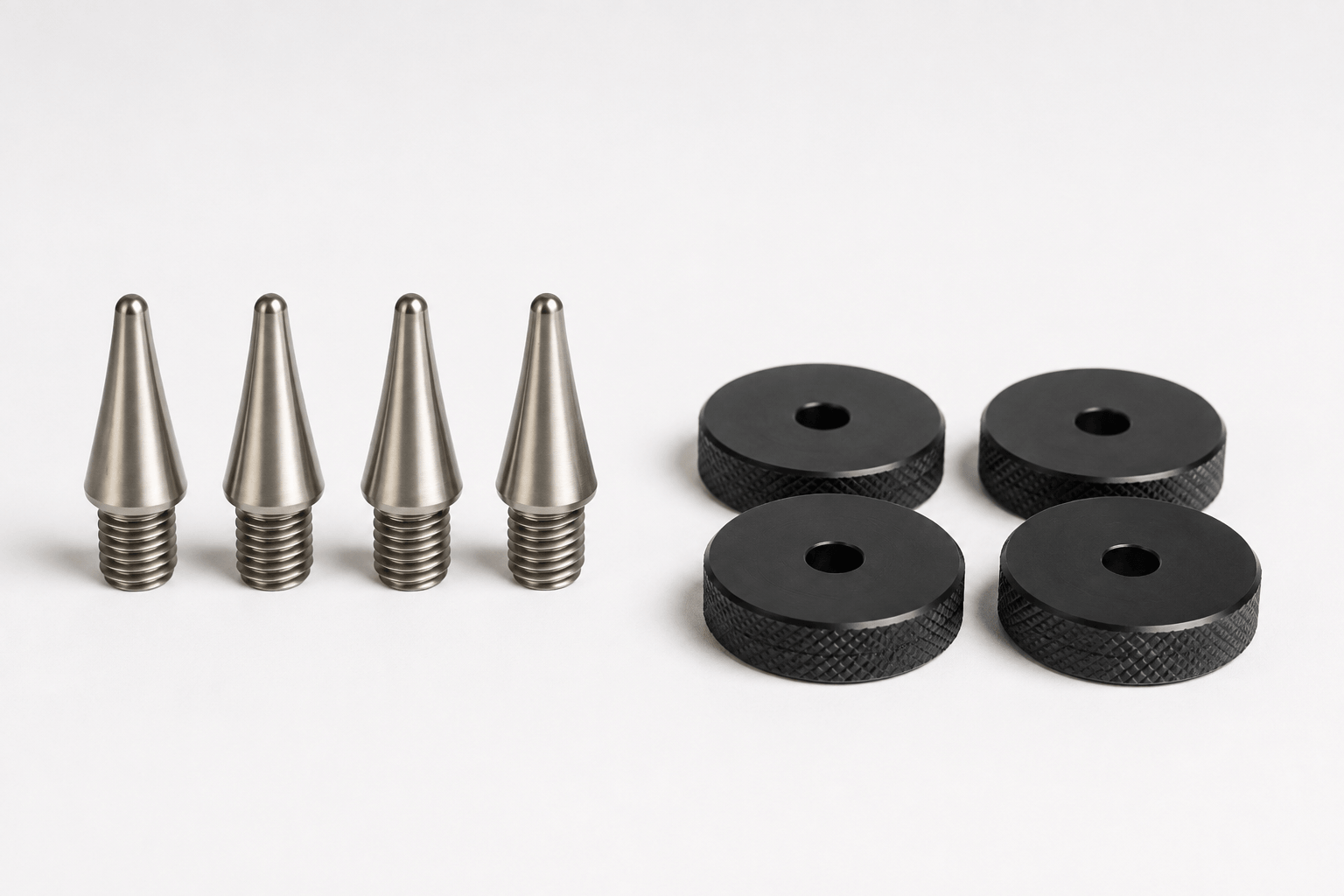
Spikes or dampers under the HiFi rack?
Spikes and dampers alter the contact between the hifi rack and the floor in different ways. Determining the right solution depends not on a sweeping promise regarding sound quality, but rather on the flooring surface, total weight, stability, and the specific vibration issues observed. Therefore, before adding accessories, one should always first verify that the hifi rack is properly assembled, leveled, and completely stable.
Those wishing to compare different designs will find suitable configurations in our “HiFi Racks” category. Accessories should then be selected specifically to match the existing combination of HiFi rack, flooring, and equipment.
Correctly positioning spikes under a HiFi rack
Spikes create small, defined contact points with the surface and, in many systems, can simultaneously be used for leveling. On carpet, depending on the design, they can help establish firm contact with the underlying floor. Whether this is intended for a specific model depends on the manufacturer’s specifications.
Hard tips must not be used unprotected on parquet, laminate or tiles. Matching shims distribute the load and protect the surface. It remains crucial that all contact points are secure and that the HiFi rack does not tip over.
Select dampers to match the load of the HiFi rack
Elastic dampers are not intended to simply eliminate movement, but rather to alter the mechanical coupling. To ensure controlled performance, the material and hardness must be matched to the actual load. Elements that are too soft can make a tall rack feel unstable and compromise its steadiness.
Consider the weight of the fully loaded rack, not just the empty unit. If equipment is added or replaced later, the load may change so significantly that dampers which were previously suitable no longer operate within the intended range.
Spikes or dampers on carpet and soft floors
Carpet can settle under a heavy HiFi rack, thereby altering its alignment. Therefore, check the unit’s stability immediately after setup and again after a few days. Placing soft pads on an already soft carpet is not necessarily beneficial, as this can introduce additional movement into the structure.
If the floor itself is noticeably springy, neither spikes nor small dampers will necessarily solve the underlying problem. For a sensitive turntable, placing it closer to a load-bearing wall or using a suitable wall mount may be more effective.
Protect delicate floors under the HiFi rack
Surface protection is a distinct consideration when dealing with parquet or tile flooring. Support discs—such as the Atacama HD-L – or solid, load-distributing pads must be non-slip and must not undergo permanent deformation under the weight. Improvised stacks of felt pads do not provide a reliable leveling solution for a heavy, tall HiFi rack.
Also pay attention to point loads. A heavy hifi rack concentrates its weight onto small surface areas via just a few feet. In cases of unusually high loads or sensitive flooring structures, a professional assessment may be advisable.
Test the HiFi rack without additional measures first
Before adding accessories, ensure the standard configuration is functioning correctly. Tighten all designated connections according to the instructions, level the HiFi rack, and check that the weight is evenly distributed across all feet. Loose fasteners, an uneven floor, or a cable touching the unit can themselves cause interference.
A controlled test is worthwhile only if a specific problem persists. Change just one factor at a time, and keep the location, equipment layout, and other conditions as consistent as possible. This makes it easier to assess whether the measure actually makes a difference.
Consider the HiFi rack and turntable separately
Turntables react mechanically to footfall noise and feedback. If the stylus visibly reacts when someone walks by, or if low-frequency feedback occurs, the transmission path is more tangible than a general impression of greater quietness. Such symptoms can be investigated in a more targeted manner.
A sturdy hifi rack can provide a good foundation, but highly springy floorboards remain part of the overall system. Therefore, the location should always be taken into account when troubleshooting.
Conclusion: Choose spikes or dampers based on the specific problem
Spikes and dampers are not universal indicators of quality, but rather distinct tools. Key factors include stability, floor protection, and a design suited to the load. Optimizing the basic structure first and then testing accessories in a controlled manner avoids unnecessary measures and yields a solution with clear, verifiable results.
Frequently Asked Questions About Spikes and Dampers for HiFi Racks
Do spikes leave holes in parquet or laminate flooring?
Tips applied directly can damage delicate surfaces. Use suitable support pads or the protective solution specified by the manufacturer, and verify that it sits securely under the actual load.
How soft can dampers under a HiFi rack be?
They must be suitable for the total load and must not compromise the stability of the structure. If the HiFi rack sways noticeably or shifts sideways when lightly touched, the solution used for this setup is likely too soft.
Do dampers always help against impact sound?
No; particularly with floors that are prone to bouncing, the placement of the unit can be more critical than a small elastic element placed under the HiFi rack. In the case of turntables, it is worth checking whether positioning the unit closer to a load-bearing wall—or using a suitable wall mount—yields better results.
Can spikes and dampers be combined?
Only if the rack or accessory system expressly provides for such a combination and the resulting structure remains stable. Multiple untested layers stacked on top of one another can impair load distribution and leveling.
When should I re-test after changing devices?
It is advisable to perform a check after any significant change in the total load or weight distribution. Re-examine the positioning, leveling, ground contact, and the behavior of any dampers being used.
Helpful guides on spikes and dampers for HiFi racks
- Vibrations and Resonances in the HiFi Rack – How to Find Out Which Transmission Path Is Actually Causing Interference.
- Leveling a HiFi rack on an uneven floor – How to use leveling options on carpet, parquet, or uneven surfaces.
- HiFi Rack for Turntables – Notes on structure-borne noise, level placement, and sensitive cartridges.


