
Blog
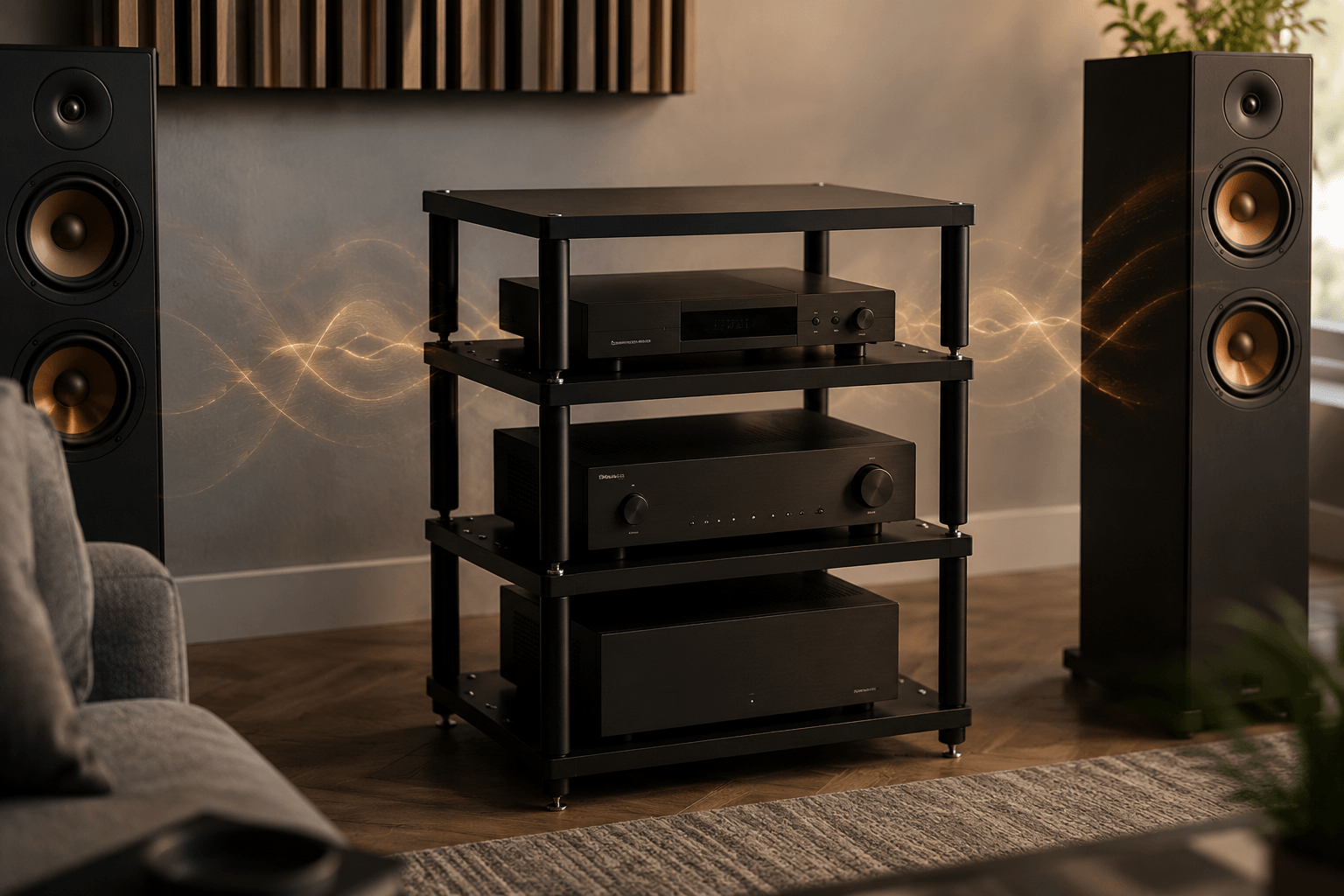
Does a HiFi rack affect the sound?
A HiFi rack, such as one from the manufacturer Atacama, can significantly improve a system’s operating conditions: equipment sits securely, ventilation paths remain unobstructed, and cables are routed neatly and without mechanical strain. However, it does not automatically follow that every HiFi rack will produce an audible improvement in sound quality with every piece of electronic equipment. It is therefore sensible to distinguish between mechanical or thermal effects—which can be readily explained—and sweeping claims regarding sound quality.
You can find various models in our “HiFi Racks” category to compare suitable designs. Nevertheless, a specific potential path of influence should always be identified when evaluating sound quality.
Turntables in HiFi racks as a special case in terms of mechanics
A turntable tracks minute mechanical movements and is therefore particularly sensitive to footfall, floor vibrations, or acoustic feedback. A stable, level surface is not merely a matter of convenience here, but a technical prerequisite for clean operation.
If the needle reacts visibly while walking or low-frequency sounds trigger feedback, the influence of the placement location can be investigated in practice. On highly springy floors, a suitable wall mount may be more effective than adding mass to the hifi rack.
Electronics in the HiFi rack: safety first
Amplifiers, DACs, streamers, and receivers reliably benefit from keeping ventilation slots unobstructed, ensuring cables are not under tension, and placing devices on sufficiently sturdy surfaces. This improves operational reliability and ease of maintenance, without automatically implying a specific effect on sound quality.
The temperature should be monitored during normal long-term operation, particularly with devices that run hot. Protective shutdowns, excessive heat, or obstructed air vents are specific issues that must be addressed first.
Objectively check cables and potential faults
A HiFi rack can help organize the placement of power supplies, power cables, and sensitive signal cables. If you encounter humming or interference, it is advisable to systematically check cable routing, connections, and proximity to power supplies—making only one change at a time.
Mechanical cable strain is also a relevant factor. A heavy cable pulling on a socket or mechanically affecting a turntable represents a clear setup error, not an abstract issue of sound quality.
Take listener expectations into account when comparing racks
Listening comparisons are susceptible to differences in volume, expectations, and visible changes. Even slight differences in level can be perceived as sounding better or more detailed. Therefore, comparisons should ideally be conducted under constant conditions.
Anyone wishing to test accessories or a different setup should change only one factor and compare the same musical passages repeatedly. In the case of very subtle differences, a comparison conducted as blindly as possible can help reduce expectation effects.
Evaluating resonances on the HiFi rack specifically rather than in general terms
Any structure is capable of mechanical vibration, yet not every vibration is automatically audible or problematic. Rattling parts, an unstable base, or a turntable setup prone to feedback are specific issues to address; these should be remedied first.
Spikes, dampers, or additional bases are more appropriate when a specific transmission path is known. Conversely, using accessories without a diagnosed problem complicates assessment because multiple variables are altered simultaneously.
Reliable benefits of a well-planned HiFi rack
Regardless of debates about sound quality, a suitable hifi rack offers measurable advantages: documented load capacity, defined shelf space, improved accessibility, organized cabling, and predictable ventilation. For heavy equipment, effective weight distribution also enhances stability.
These criteria alone are a good reason to select a hifi rack carefully. Additional measures to enhance sound quality can subsequently be considered where there is a specific need.
Conclusion: Link sound issues to specific causes
A hifi rack can influence sound quality—particularly with mechanically sensitive source components—if it alters the actual conditions of the setup. For standard electronic equipment, however, a stable platform, proper cooling, and neat cabling offer more reliable benefits. Conducting controlled listening tests and investigating specific interference paths yields more robust answers than relying on sweeping claims.
Frequently Asked Questions About Sound in HiFi Racks
Does an expensive HiFi rack automatically sound better?
No, price and material alone do not guarantee an audible benefit. First, check whether the hifi rack is technically compatible with the system and whether there is actually a specific mechanical or electrical problem.
Why is a turntable more sensitive than a streamer?
A turntable converts mechanical movement into an electrical signal and can therefore be susceptible to footfall noise and feedback. A streamer does not involve this mechanical tracking process, yet it still requires stable placement, cooling, and interference-free connections.
Can a HiFi rack eliminate hum?
Only if the cause is related to the setup, cable routing, or the positioning of power supplies and cables. When dealing with a hum, you should systematically change only one factor at a time so that the cause can be narrowed down.
Is a HiFi rack worth it even without an audible effect on the sound?
Yes, because load-bearing capacity, organization, ventilation, ease of use, and maintenance access are distinct practical advantages. A HiFi rack can therefore make sense, even if a listening comparison reveals no difference.
How do I test changes to the rack as fairly as possible?
Keep the volume, music material, and the rest of the setup constant, and change only one variable. Repeat the comparison several times; for very subtle impressions, a procedure that is as blind as possible is more helpful than a single A/B comparison.
Further guides on the sound and positioning of the HiFi rack
- Vibrations and Resonances in HiFi Racks – How to Investigate Specific Mechanical Interference Paths Instead of Relying on Sweeping Promises About Sound Quality.
- HiFi Rack for Turntables – Why Turntables Are Particularly Sensitive to Placement, Structure-Borne Noise, and Alignment.
- Spikes or dampers under the HiFi rack? – Here is how to evaluate accessories based on the substrate, stability, and the specific problem.


