
Blog
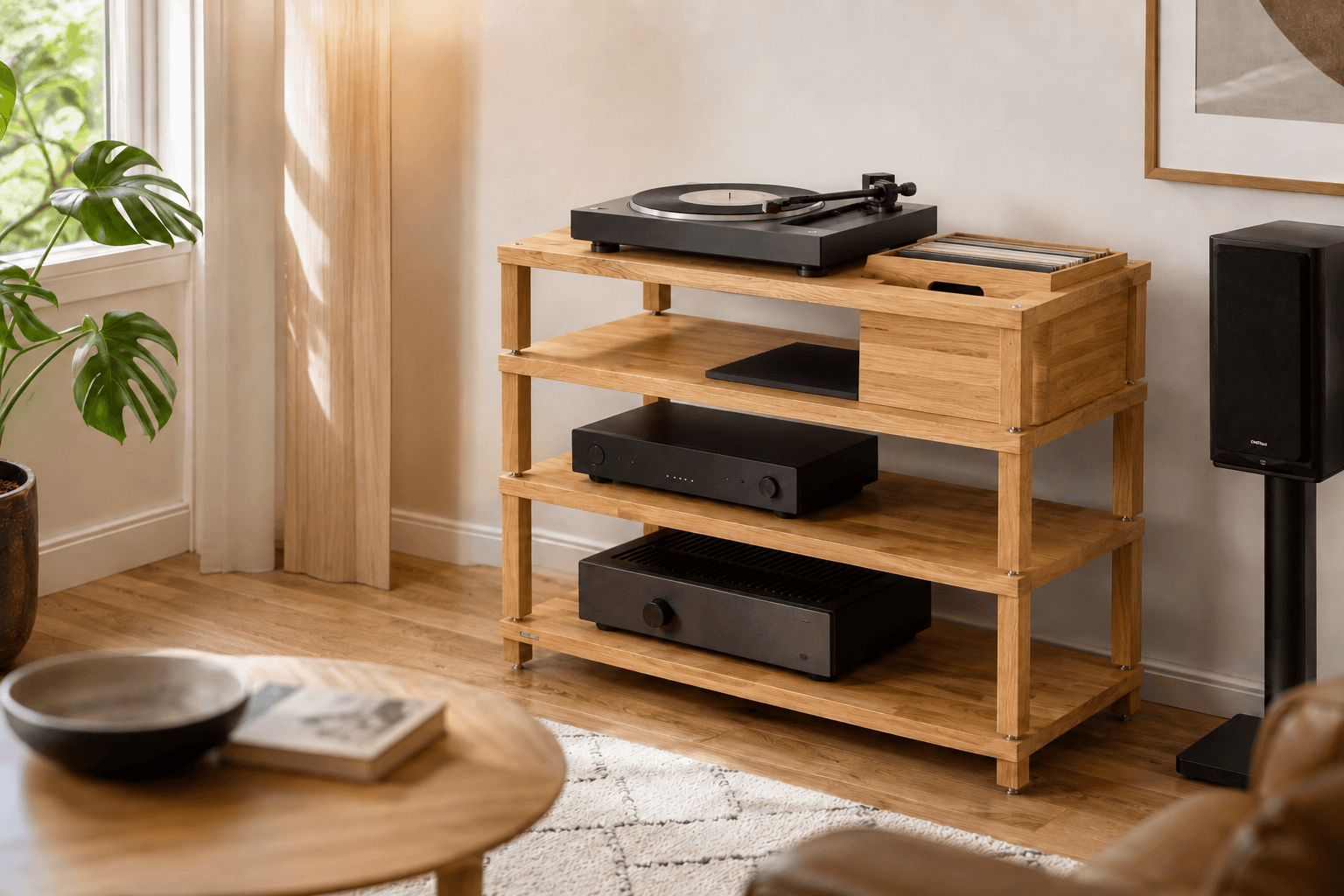
HiFi Rack for Turntables
Above all, a hifi rack for a turntable must provide a stable, level, and easily accessible surface. Unlike many digital sources, a turntable tracks mechanical movements and is therefore more sensitive to footfall, vibrating floors, or an uneven setup. At the same time, the dust cover, tonearm, and cables require sufficient clearance for movement.
Those wishing to compare different solutions will find a variety of designs in our “HiFi Racks” category. However, before making a selection, you should determine the dimensions of the turntable, the space required for the open dust cover, and the conditions at the intended location.
Making effective use of the top shelf of the HiFi rack
For many turntables, the top shelf of a rack is ideal because the tonearm, record, and controls remain easily accessible. Furthermore, there is no other component positioned directly above the turntable that could obstruct the dust cover or generate additional heat. The Atacama Apollo Podium 10 HiFi rack is particularly noteworthy, as it offers storage space for vinyl records in addition to accommodating a turntable.
Check the actual footprint using the device feet. The housing may visually appear larger than the support surface, but it is crucial that all feet are securely on the floor and that no column or edge impedes operation.
Level the turntable horizontally in the HiFi rack
A spirit level should be used both lengthwise and crosswise once the HiFi rack is in its final location. Adjustable feet or spikes are adjusted so that all contact points bear weight and the unit does not wobble.
It is worth performing a second check after fully loading the vehicle. Carpeting or other yielding surfaces can settle under the total weight and alter the initial, precise alignment.
Take impact sound and resilient floors into account
On wooden floorboards or other sprung floors, every step can be transmitted to the turntable. A sturdy HiFi rack does not automatically eliminate movement in the building’s floor. Therefore, it is worth checking first whether a different location closer to a load-bearing wall offers a more stable surface.
In cases of significant problems, a suitable wall mount can be an alternative. Additional mass, spikes, or dampers should only be tested once it is clear which transmission path is actually causing the disturbance.
Planning the distance between the HiFi rack and the speakers
Loudspeakers generate airborne sound and can also transmit vibrations through the floor. Therefore, a turntable should not be directly coupled to a loudspeaker cabinet. Positioning it where strong bass excitation leads to feedback is also unfavorable.
There is no fixed, universal minimum distance, as the room, speakers, and turntable all react differently. Observe the system at typical listening volumes, and if problems arise, initially change only the placement so that the effect remains easy to track.
Factor in the turntable dust cover and operating height
Do not measure only the height of the unit when closed. Many dust covers swing upwards and slightly backwards when opened. Therefore, sufficient space must be left behind the HiFi rack to ensure the cover does not hit the wall, cables, or other objects.
The operating height is also a relevant factor. A very tall HiFi rack can make placing a record awkward, while one that is too low forces you to bend down significantly. If possible, simulate the height before making a purchase.
Route phono cables and power supplies neatly
Phono cables are often relatively short and should be routed to the amplifier or phono stage without being under tension. Ensure that the cable does not exert mechanical pull on the turntable and that the connectors are not subjected to lateral stress.
External power supplies or transformers should not be left unchecked directly next to sensitive phono stages. If there are hum problems, a systematic test makes sense: change only one position or cable route at a time and then listen again.
Check the load capacity and stability of the rack level
Even though a turntable is usually lighter than a large power amplifier, the designated shelf must be operated within its rated load capacity. Additional bases, heavy slabs, or accessories increase the load and must be factored into the calculation.
The entire assembly should be mounted without any play. Any loose connections or instability must be remedied before attempting additional decoupling measures.
The bottom line: Controlled placement is what counts for a turntable
A good HiFi rack for turntables creates a horizontal, stable and easy-to-use base. Location, building floor, free hood movement and tension-free cable routes are particularly important. Anyone who clarifies these points first can then use accessories specifically instead of on suspicion.
Frequently Asked Questions About HiFi Racks for Turntables
Does a turntable always have to sit on top of the hifi rack?
No, the crucial technical factors are stability, a level surface, and ease of use. The top level is often convenient because the lid can open freely and there is no other appliance positioned above it.
Do you need a stone slab under the turntable?
Not necessarily. An additional board should only be used once the load-bearing capacity, support conditions, and a specific mechanical objective have been clarified; adding mass does not solve every impact sound problem.
How do you check if the HiFi rack is level?
Use a suitable spirit level in two directions and adjust the designated feet incrementally. Check again after the unit is fully loaded, as carpeting or other floor surfaces may settle.
How far away should the turntable be from the speakers?
There is no universal distance. It is important to avoid direct mechanical coupling and audible feedback; if problems arise, the location should be adjusted incrementally.
What can be done about loud impact noise?
First, try a location closer to a load-bearing wall and check whether the floor is the cause of the problem. In cases of significant issues, a suitable wall mount may be a better solution than piling more and more accessories onto the HiFi rack.
More guides on HiFi racks for turntables
- Vibrations and Resonances in the HiFi Rack – How to Identify Structure-Borne Noise, Feedback, and Other Mechanical Interference Paths.
- Spikes or dampers under the HiFi rack? – How to evaluate rack feet and dampers based on the flooring.
- Does a HiFi rack affect the sound? – Why turntables represent a special mechanical case when it comes to sound quality.


